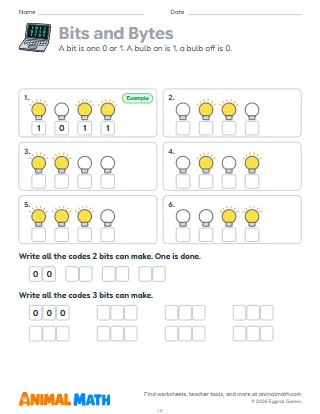
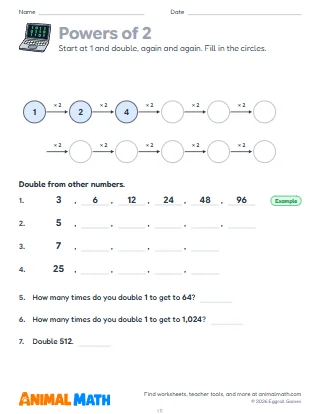
Computers store everything, from numbers and letters to pictures and music, as long strings of 0s and 1s, because a tiny switch inside them can only be off or on. That is binary, a number system with two digits. Our numbers have places worth 1, 10, 100 and so on, each ten times the one on its right; binary has places worth 1, 2, 4, 8, 16 and so on, each two times the one on its right. Computer Science Education Week, held every December in the week of Grace Hopper's birthday (December 9, 1906), is a good time to try it: she helped make some of the first programming languages, so people could write code for computers in words.
Seven pages of binary numbers, with no computer needed. Page 1 introduces the binary cards: each card has twice the dots of the card on its right, and a card face up is a 1, face down a 0. Students write the code under each row of cards and count the dots that show. Page 2 gives a binary code: write the value of each 1 (and 0 for each 0) under it and add. Page 3 goes the other way: start with the biggest card that fits, take it away, and keep going. Page 4 fills in the missing codes from 0 to 15 and asks about the patterns, such as why every odd number ends in 1. Page 5 turns codes into numbers and numbers into letters to read four secret messages, and page 6 writes words in binary and makes a binary bracelet, a colored bead for each 1, with the student's own initials at the end. Page 7 is a challenge with a sixth card worth 32. The first problem on each page is worked as an example.
Make five big cards (or use paper plates) with 1, 2, 4, 8 and 16 dots, and give them to five students standing in a row, the 16 on the left. Call out a number and let the class decide which cards to turn over. Before page 4, ask what happens to the 1 card as you count up: it flips every time. Page 6's bracelets can be made for real with beads in two colors and a pipe cleaner.
Count on your fingers in binary: each finger, from the thumb, is worth 1, 2, 4, 8 and 16 when it is up. One hand counts to 31. Then send each other short secret notes in the page 5 code.
Binary numbers, the code computers use, as place value with cards worth 16, 8, 4, 2 and 1, where a card face up is a 1 and face down is a 0. Students turn codes into numbers and numbers into codes, find the patterns in counting to 15, decode secret messages letter by letter and write their own words and initials in binary.
Tell us what to make next, or build your own with a worksheet maker.
This worksheet is free to download, print, copy, and hand out in your classroom or at home. You do not need to create an account, and there are no watermarks on the PDF.