Loading preview...

Skills Covered

  • Read amounts with fractions and mixed numbers on a recipe card
  • Add and subtract fractions with like and unlike denominators
  • Double and triple a recipe: multiply a fraction by a whole number
  • Halve a recipe: multiply a fraction by 1/2 on an area model
  • Scale a recipe for more or fewer servings, by 1/2 and 1 1/2
  • Find the cost of a batch, the cost of one muffin and the profit

How to Use This Pack

Five pages of fractions in the kitchen. Page 1 has two recipe cards: students find which ingredient uses the most or fewest cups, how many more cups of one than another, and how much in all (like denominators on the pancake card, unlike denominators on the muffin card). Page 2 doubles a cookie recipe and triples a lemonade recipe in tables: multiply each amount, then write it in simplest form (2 × 3/4 = 6/4 = 1 1/2). Page 3 finds half of an amount by shading an area model, then halves a banana bread recipe (2 eggs make 1 egg). Page 4 finds what to multiply by when a recipe for 4 serves 8, 12, 2 or 6 people, scales a smoothie recipe to serve 2 and 6, and solves two stories with mixed numbers. Page 5 picks the two measuring cups that make an amount like 5/6 cup, then uses a shopping list to find what a bake sale batch of 24 muffins costs, the cost of one muffin, the money taken in and the profit. Each table and set of problems starts with a worked example.

In the Classroom

Bring a real recipe card and ask what would change to feed the whole class. Before page 2, measure 3/4 cup of rice twice into a bowl and check that it makes 1 1/2 cups. Before page 3, fold a paper rectangle into thirds, shade 2/3, then fold it in half the other way to see half of 2/3. Page 5 is a good start for planning a real class bake sale: list the ingredients, find the prices and work out a fair price for each item.

At Home

Pick a family recipe and double or halve it together, writing each new amount before you measure. Ask which measuring cups you would use for an amount like 3/4 cup or 1 1/3 cups. At the store, add up the cost of the ingredients and work out what one serving costs.

Tips for Success

  • To double a recipe, multiply every amount by 2; to halve it, multiply by 1/2
  • Write a mixed number as a fraction before you multiply: 1 1/2 = 3/2
  • Simplify the answer: 6/4 = 1 2/4 = 1 1/2
  • New servings ÷ old servings tells you what to multiply by: 6 ÷ 4 = 1 1/2
  • 3/8 cup is not on a measuring cup: use 1/4 cup and 2 tablespoons

Common Core Standards Alignment

This pack supports the following Common Core State Standards for Mathematics:

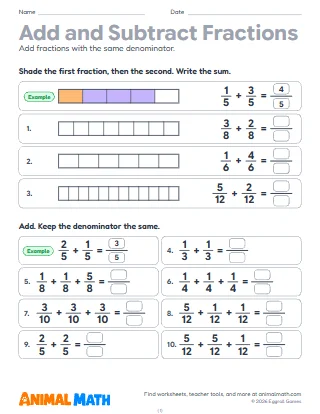
  • 4.NF.B.3a Understand adding and subtracting fractions as joining and taking away parts of the same whole.
  • 4.NF.B.3c Add and subtract mixed numbers with the same denominator, for example by changing them to fractions or by using properties of operations.
  • 4.NF.B.3d Solve story problems that add or subtract fractions of the same whole with like denominators, using fraction models and equations.
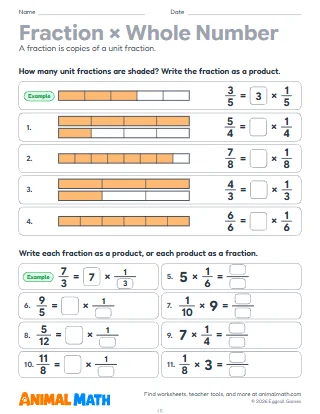
  • 4.NF.B.4a See a fraction a/b as a copies of 1/b, such as 7/3 = 7 × (1/3), and show it with a fraction model.
  • 4.NF.B.4b Find a whole number times a fraction by counting unit fractions: 4 × (2/3) is 8 copies of 1/3, which is 8/3.
  • 4.NF.B.4c Solve story problems with a whole number times a fraction, using models and equations, and name the two whole numbers the answer falls between.
  • 4.MD.A.2 Solve story problems on distance, time, liquid volume, mass and money with any operation, simple fractions or decimals and unit changes, using number-line diagrams.
  • 4.MD.B.4 Make a line plot of measurements in halves, quarters and eighths, and use it to solve problems that add and subtract fractions.
  • 5.NF.A.1 Add and subtract fractions and mixed numbers with unlike denominators by rewriting them as equivalent fractions with a common denominator.
  • 5.NF.A.2 Solve story problems that add or subtract fractions of one whole, unlike denominators included, and check that answers make sense with benchmark fractions and estimating.
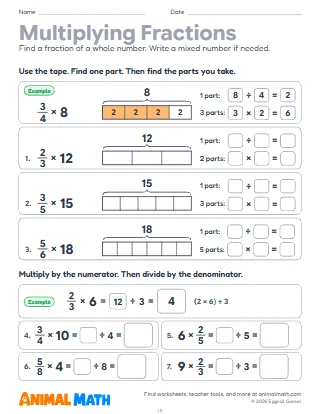
  • 5.NF.B.4a Multiply a whole number or fraction by a fraction, seeing (3/4) × 2 as 3 of the 4 equal parts of 2, using models.
  • 5.NF.B.4b Tile a rectangle with fraction side lengths using squares whose sides are unit fractions, and see the area equals the two sides multiplied.
  • 5.NF.B.5a Without multiplying, tell how the size of a product compares to one factor by looking at the size of the other factor.
  • 5.NF.B.5b Explain why multiplying by a fraction above 1 makes a number bigger and below 1 makes it smaller; see equivalent fractions as multiplying by 1.
  • 5.NF.B.6 Solve real-life problems that multiply fractions and mixed numbers, using fraction models or equations.
  • 5.MD.A.1 Change measurements between bigger and smaller units of one system, such as 250 cm to 2.5 m, and use this in multi-step real-life problems.
  • 5.MD.B.2 Make a line plot of measurements in halves, quarters and eighths, and solve problems from it with fraction operations, like sharing a total equally.

© Copyright 2010. National Governors Association Center for Best Practices and Council of Chief State School Officers. All rights reserved.

Recipe Math

4th – 5th Grade

A 5-page recipe fractions pack for 4th and 5th grade. Read a pancake recipe card and a muffin recipe card to find the most and fewest cups, how much more and how much in all, with like and unlike denominators. Double a cookie recipe and triple a lemonade recipe, halve amounts on area models and in a banana bread recipe, and scale a smoothie to serve 2 and 6 people. Choose two measuring cups that make an amount, then find what a bake sale batch costs, the cost of one muffin and the profit. Every page comes in color and in black and white. Answer keys included.

Download PDF
Pin

What’s Included

  • 5 worksheets in color and in black and white, with answer keys (15 pages)
  • Two recipe cards to read: most and fewest, how much more, how much in all
  • Double, triple and halve a recipe in tables, with area models for halving
  • Scale a recipe by servings, choose measuring cups, and find the cost of a bake sale batch
Can’t find what you need?

Tell us what to make next, or build your own with a worksheet maker.

Suggest a worksheet

Free to print and share

This worksheet is free to download, print, copy, and hand out in your classroom or at home. You do not need to create an account, and there are no watermarks on the PDF.