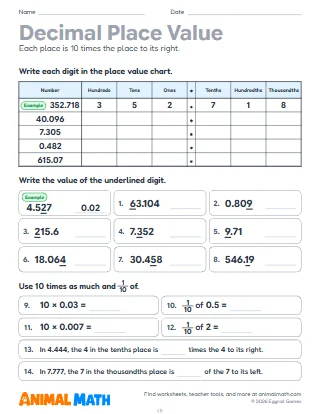
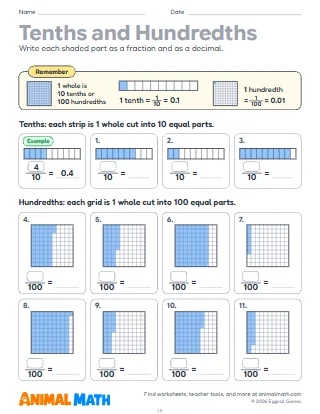
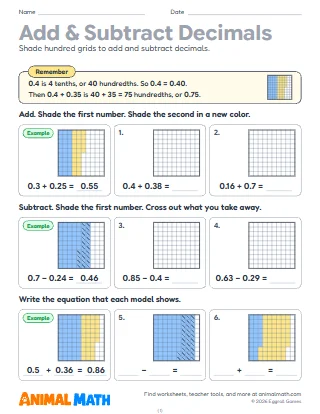
Five pages for Year 4 on rounding numbers with one decimal place to the nearest whole number. Page 1 shows each number above a number line from one whole number to the next, marked in tenths with the halfway point longer: children mark the number and write the whole number it is nearer. Page 2 is a list of thirty numbers to round, the first twelve under 20 and the rest up to 100, with a few halves, which round up. Page 3 rounds everyday measures in kilograms, metres, litres, kilometres, centimetres and degrees Celsius. Page 4 asks children to circle every number in a row that rounds to a given whole number, then to find the smallest and largest one-place number that does. Page 5 rounds both numbers to estimate a sum or difference, then uses the same idea in three short word problems.
Draw a number line from 3 to 4 on the board, mark the tenths and ask where 3.7 goes. Is it nearer 3 or 4? Then try 3.5 and agree that halves round up. Page 4 makes a good talking point: how many numbers with one decimal place round to 8, and which is the largest?
Look for measures with one decimal place: the weight on a bag of flour, a distance on a sign or the temperature in the weather forecast. Ask your child to round each one to the nearest whole number and to say which whole number it is nearer.
This pack supports the following Common Core State Standards for Mathematics:
© Copyright 2010. National Governors Association Center for Best Practices and Council of Chief State School Officers. All rights reserved.
Rounding numbers with one decimal place, such as 3.7, to the nearest whole number. Students place each number on a number line, round lists and everyday measures, find which numbers round to a given whole number and round to estimate.
Tell us what to make next, or build your own with a worksheet maker.
This worksheet is free to download, print, copy, and hand out in your classroom or at home. You do not need to create an account, and there are no watermarks on the PDF.