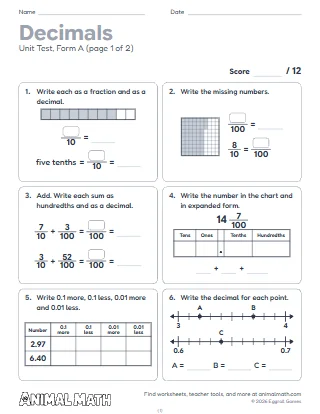
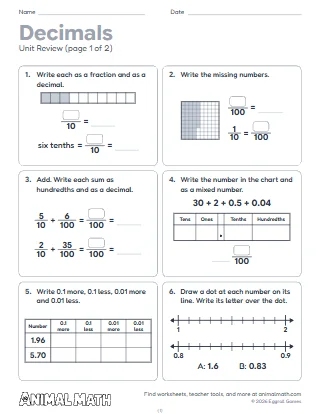
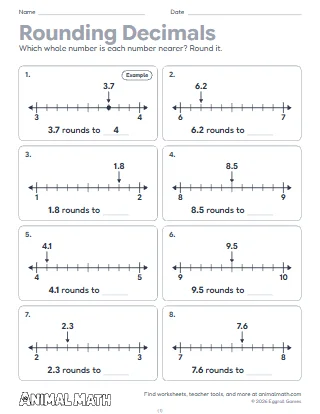
Five pages that introduce decimals as another way to write tenths and hundredths. Page 1 shows tenths strips and hundred grids; students write each shaded part as a fraction and as a decimal, such as 52/100 = 0.52. Page 2 makes a dollar the whole: a dime is one tenth and a penny one hundredth, so 4 dimes and 6 pennies are 46/100 of a dollar, or $0.46. A table then makes amounts like $1.45 from the fewest dollars, dimes, and pennies. Page 3 renames tenths as hundredths (3/10 = 30/100), adds tenths and hundredths, and writes halves, fourths, and fifths as decimals. Page 4 reads and marks points on three number lines, fills a place value chart with expanded form, and finds 0.1 and 0.01 more or less. Page 5 compares shaded grids, then decimals like 0.5 and 0.45, decides whether a decimal is closest to 0, 0.5, or 1, and orders decimals from least to greatest.
Start with real dimes and pennies: ten dimes make a dollar and so do a hundred pennies, so a dime is a tenth and a penny a hundredth. Shade 3 columns of a hundred grid together and count them as 3 tenths, then as 30 hundredths. On page 5, ask students who say 0.38 is more than 0.4 to shade both on a grid.
Read prices out loud as dollars, dimes, and pennies: $2.45 is 2 dollars, 4 dimes, and 5 pennies. Ask which is more, 0.6 or 0.06 of a dollar, and check with coins.
This pack supports the following Common Core State Standards for Mathematics:
© Copyright 2010. National Governors Association Center for Best Practices and Council of Chief State School Officers. All rights reserved.
Decimals as another way to write tenths and hundredths. Students write shaded grids and coins as decimals, add tenths and hundredths, use number lines and a place value chart, and compare and order decimals.
Tell us what to make next, or build your own with a worksheet maker.
This worksheet is free to download, print, copy, and hand out in your classroom or at home. You do not need to create an account, and there are no watermarks on the PDF.