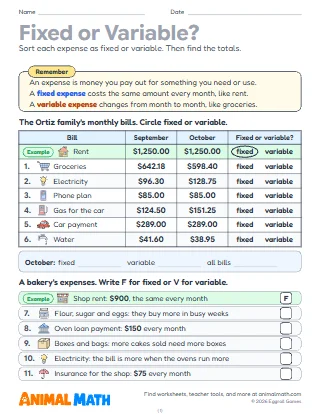
Five pages that follow Bead Buddies, a friendship bracelet business, with a bake sale table called the Cookie Corner alongside. Page 1 explains the two kinds of costs: start-up costs are paid once (a table, a sign, a cash box), and supply costs are paid again for every batch (beads, string). Students circle start-up or supply for eight things on a shopping list, total each kind, then fill in the Cookie Corner's first three batches, where only batch 1 pays the start-up costs. Page 2 finds the cost of one item from a batch (or the batch cost, or how many a batch makes), then the profit at four prices from a class survey, the price that makes the most profit, and whether a price is too high or too low. Page 3 is a week's sales record at a fair: count the tally marks, find the money taken in each day and the totals, draw a bar graph and read it. Page 4 is a four-week income statement: circle profit or loss for each week and the total, explain the week that lost money, and solve two story problems. Page 5 builds a running table of profit until the start-up costs are paid back, finds the exact break-even number, sees what changes when the price or a cost changes, and solves two break-even stories. The first problem of each kind is worked as an example.
Before page 1, plan a pretend class bake sale on the board: list what you would buy and ask which things you keep and which get used up. For page 2, run a real price survey: ask the class how many would buy a cookie at 25¢, 50¢ and $1, then work out which price earns the most. Page 3 pairs well with a real sales tally from a school fundraiser. Before page 5, ask how many sales it takes before a lemonade stand has paid for its pitcher.
If your child has sold something (lemonade, crafts, a car wash), sit down together and list the start-up costs and the supplies. Work out what one item cost to make and what the profit was on each. Talk about the price: what happens if it is higher, and what happens if it is lower. Keep a simple sales record for a garage sale or bake sale and see whether it made a profit.
This pack supports the following Common Core State Standards for Mathematics:
© Copyright 2010. National Governors Association Center for Best Practices and Council of Chief State School Officers. All rights reserved.
A 5-page financial literacy pack for 4th and 5th grade that follows a kid's bracelet business from start to finish. Sort a shopping list into start-up costs (paid once) and supply costs (paid for every batch), and total each. Find the cost of one item from a batch, the profit on one bracelet at four prices, and the price that makes the most profit. Keep a week's sales record from tally marks and draw a bar graph, fill in a four-week income statement with a profit or loss each week, and find how many bracelets pay back the start-up costs. Every page comes in color and in black and white. Answer keys included.
Tell us what to make next, or build your own with a worksheet maker.
This worksheet is free to download, print, copy, and hand out in your classroom or at home. You do not need to create an account, and there are no watermarks on the PDF.