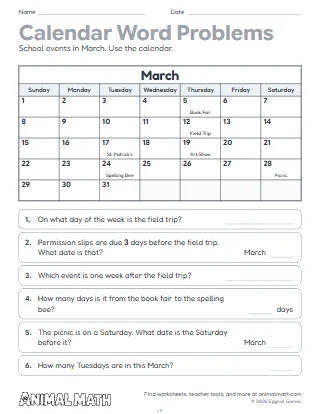
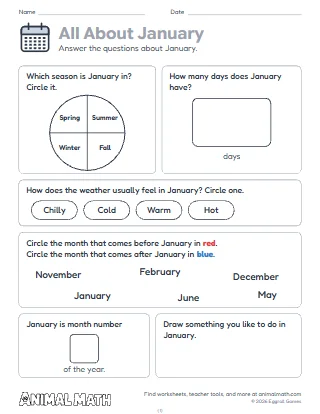
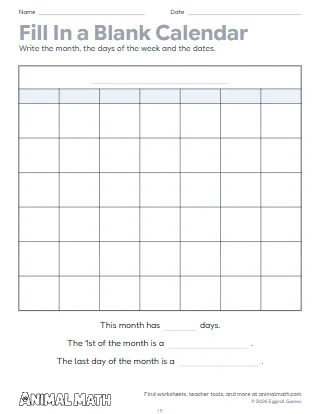
For Anishinaabe (Ojibwe) families of the Great Lakes, the year has long been a seasonal round: moving with the food as it comes ready. In late winter and early spring families go to the sugar bush to boil maple sap; gardens are planted in late spring; strawberries and blueberries ripen in summer; wild rice (manoomin) is harvested by canoe in late summer; whitefish are netted in the fall; and winter is spent at a winter camp. Many of these are still done today. The Ojibwe year has thirteen moons, named for what happens in them, like the Boiling Sap Moon and the Ricing Moon, so the months on these pages are about. The months come from the National Park Service, Ojibwe language and tribal sources.
Five pages of 2nd and 3rd grade calendar math. Page 1 is the circle calendar with six questions to read from it. Page 2 counts the months from the start of one job to the next, going round the circle and past December. Page 3 finds months later and earlier, then numbers the year's work in order. Page 4 is an April calendar of the days the sap ran, with six questions. Page 5 has May and June calendars for a Three Sisters garden: corn first, then beans and squash two weeks later. The first question on each page is a worked example.
Look at the circle together first: where is January, which way do the months go, and which job comes when? Ask why a calendar of a year's work might be drawn as a circle rather than a line.
Draw your own family's year as a circle: birthdays, holidays, school starting, the first snow.
This pack supports the following Common Core State Standards for Mathematics:
© Copyright 2010. National Governors Association Center for Best Practices and Council of Chief State School Officers. All rights reserved.
Calendar math on a circle calendar of the seasonal round, the year's work of an Anishinaabe (Ojibwe) community in the Great Lakes, from the spring sugar bush to the wild rice harvest. Students read the circle, count months going round it, find months later and earlier, read a month calendar and work out the days in a Three Sisters garden.
Tell us what to make next, or build your own with a worksheet maker.
This worksheet is free to download, print, copy, and hand out in your classroom or at home. You do not need to create an account, and there are no watermarks on the PDF.