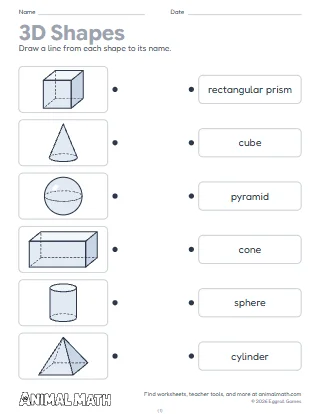
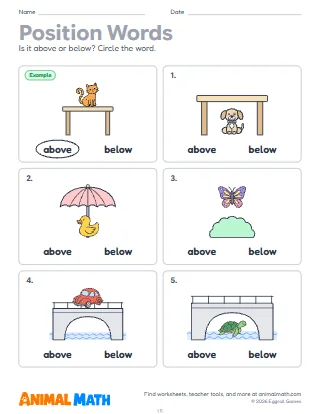
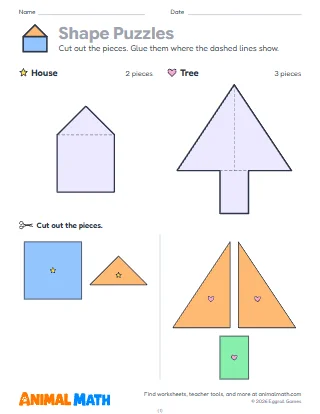
Three sorting pages and two position pages, all cut and glue. On pages 1 to 3 students cut out ten shape cards and glue each one in its tray: flat or solid on page 1, 3 sides, 4 sides or round on page 2, and rolls, stacks or both on page 3 (spheres and cones roll, cubes stack, cylinders do both). The shapes come in different sizes and turns, so a long thin rectangle and a tipped square still count, and every card fits exactly one tray. A talk-about-it question under the trays asks how two shapes are alike and how they are different. On page 4 students cut out flat shapes and glue them in a park where five clues say: above the box, next to the box, on top of the square, under the tree, between the box and the tree. Page 5 does the same with solid shapes in a room with a table. The keys show one right way to place each shape.
Bring a ball, a block, a party hat and a can, and sort them together: which roll? which stack? Then hold up a paper circle and the ball: how are they alike? How are they different? For the position pages, read each clue aloud and act it out with a real box and a toy before students glue.
Go on a shape hunt and sort what you find: flat things (a coaster, a card) and solid things (a ball, a can). Try rolling and stacking each one. Then play "Where is it?": hide a toy and give clues like "It is under the table, next to the chair."
This pack supports the following Common Core State Standards for Mathematics:
© Copyright 2010. National Governors Association Center for Best Practices and Council of Chief State School Officers. All rights reserved.
A 5-page cut-and-glue shapes pack for kindergarten. Sort ten shape cards into trays: flat or solid, 3 sides, 4 sides or round, and solid shapes that roll, stack or do both, with a talk-about-it question on how two shapes are alike and different. Then cut out shapes and glue them where the clues say: a circle above the box, a triangle on top of a square, a sphere under the table, a cylinder next to it. Every page comes in color and in black and white. Answer keys included.
Tell us what to make next, or build your own with a worksheet maker.
This worksheet is free to download, print, copy, and hand out in your classroom or at home. You do not need to create an account, and there are no watermarks on the PDF.