Summer brings the hottest days of the year and the strongest sun. The UV index, given with the weather forecast, says how strong the sun's ultraviolet rays are: at 3 or more, skin needs protection, and in the middle of a summer day it can reach extreme. Doctors advise putting sunscreen on 15 minutes before going out and again every 2 hours, and after swimming. These pages use those habits for their math.
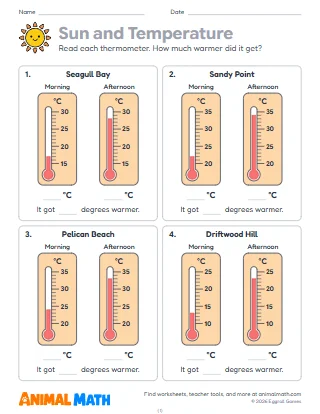
Six pages. Page 1 shows a morning and an afternoon thermometer for four beach towns, in °F with a mark every 2 degrees: write both temperatures and how much warmer it got. Page 2 gives a week of high temperatures in a table: plot them as a line graph, then find the hottest and coolest days, the days of 90°F or more and the biggest rise and drop. Page 3 is a line graph of one hot day, every 2 hours, to read and answer questions about. Page 4 is a day of UV index readings: write each hour's category from the key, then find the highest reading and when sun protection is first and last needed. Page 5 reads a clock for when sunscreen went on and finds when it goes on again, then marks a day at the beach on a time line. Page 6 is six word problems.
Look up the day's UV index together (the weather forecast gives it) and compare it with page 4. Keep a class chart of the high temperature each day for a week and graph it the way page 2 does. For page 5, count on in hours first, then minutes, and watch for the change from a.m. to p.m. at noon.
Check the forecast's high each morning for a week and write it down, then compare the hottest and the coolest day. At the beach or the pool, note when the sunscreen goes on and work out together when it is due again.
This pack supports the following Common Core State Standards for Mathematics:
© Copyright 2010. National Governors Association Center for Best Practices and Council of Chief State School Officers. All rights reserved.
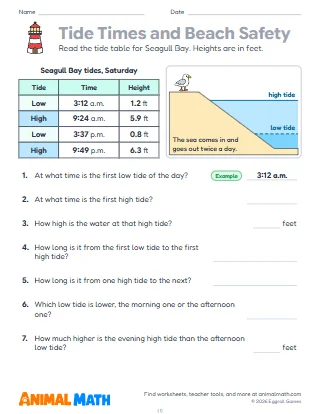
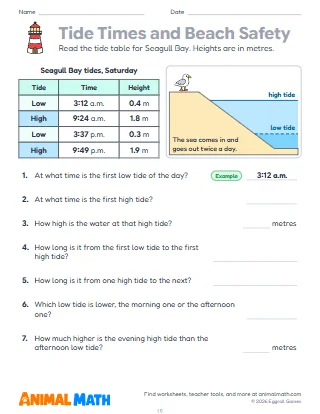
Summer temperatures in degrees Fahrenheit, the UV index and sunscreen times on hot days at the beach. Students read thermometers, graph a week of high temperatures, read a hot day hour by hour, sort UV readings into categories, find when sunscreen goes on again and solve word problems.
Tell us what to make next, or build your own with a worksheet maker.
This worksheet is free to download, print, copy, and hand out in your classroom or at home. You do not need to create an account, and there are no watermarks on the PDF.