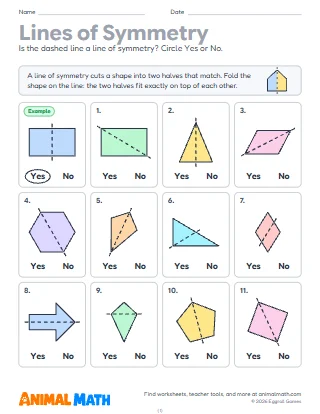
Five pages about symmetry in things children see every day. Page 1 starts with a worked example, a butterfly with a dashed line down the middle, then students circle Yes or No for eleven more pictures. Some lines are lines of symmetry; others go through a cup with a handle, a snail or a shoe, or sit off center or slanted on a house and a tree. On page 2 students draw a line of symmetry on each picture, some up and down, some across, like a pencil and a carrot; the answer key shows every line, such as the five on a star. Page 3 gives half of a house, a heart, a tree, a rocket, a fish and a butterfly on a square grid, and students count squares to draw the other half so both halves are the same shape and size. Page 4 asks students to fold flat shapes in their heads, draw every line of symmetry and write how many, from a rectangle with 2 to a plus sign with 4 and the letter F with none. Page 5 shows half of an object cut along its line of symmetry, and students circle the whole object among three choices, then draw an object of their own with a line of symmetry.
Before page 1, fold a paper heart and a paper butterfly in half so students see the two halves fit exactly. Hold a small mirror on the dashed lines: when the picture in the mirror finishes the drawing, the line is a line of symmetry. Cut the flat shapes from page 4 out of paper and let students fold them to check their answers.
Go on a symmetry hunt at home: a window, a door, a plate, a shirt, a leaf. Fold a piece of paper, paint on one side, and press the halves together to make a symmetric butterfly. Cut a heart from folded paper and open it to find the line of symmetry along the fold.
This pack supports the following Common Core State Standards for Mathematics:
© Copyright 2010. National Governors Association Center for Best Practices and Council of Chief State School Officers. All rights reserved.
A 5-page symmetry pack for 1st and 2nd grade. Decide whether a dashed line is a line of symmetry on pictures of everyday things, from a butterfly and a crown to a cup with a handle and a snail, then draw a line of symmetry on each picture. Finish half pictures on a square grid so both halves match, fold flat shapes to find every line of symmetry and count them, and use a line of symmetry to pick the whole object from half of it before drawing an object of your own. Every page comes in color and in black and white. Answer keys included.
Tell us what to make next, or build your own with a worksheet maker.
This worksheet is free to download, print, copy, and hand out in your classroom or at home. You do not need to create an account, and there are no watermarks on the PDF.