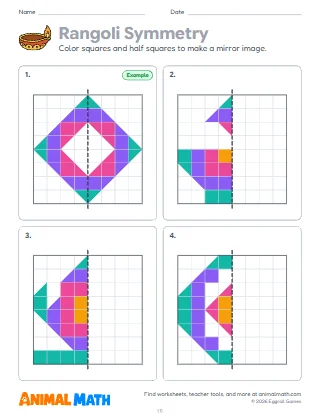
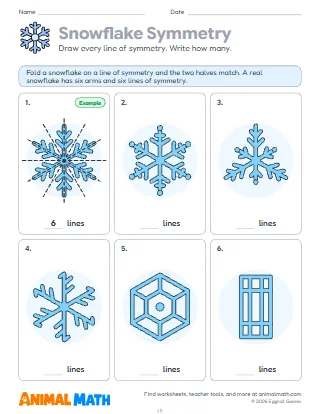
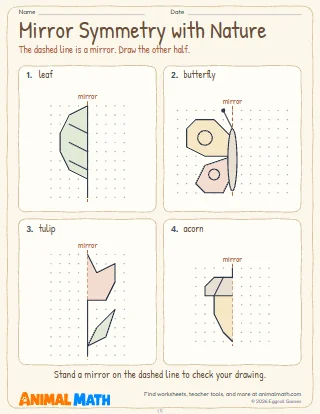
Five pages about lines of symmetry in polygons, from yes-or-no to drawing your own. Page 1 shows twelve polygons, each with one dashed line, and students circle Yes or No: is it a line of symmetry? It includes the lines that fool people, like a rectangle's diagonal and a parallelogram's diagonal. On page 2 students draw one line of symmetry on each of twelve shapes, from an isosceles triangle to an arrow and a crown. Page 3 asks for every line of symmetry and how many there are, for a square, a rectangle, three kinds of triangles, a kite, a rhombus, a parallelogram, a trapezoid and regular polygons up to the octagon. Page 4 gives half of a polygon on a square grid and students draw the other half, across a line that goes up and down, across, and on a slant. Page 5 sorts twelve numbered polygons into 0, 1, 2 or more than 2 lines, compares a square with a rectangle, and has students draw polygons with exactly 1 and exactly 2 lines of symmetry.
Before page 1, cut a paper rectangle and fold it along a diagonal: the corners stick out, so the diagonal is not a line of symmetry. Fold it in half the long way and the short way to find its two real lines. Give each pair of students a paper square, an equilateral triangle and a parallelogram to fold before page 3, and a small mirror to stand on the dashed lines of page 4.
Look for lines of symmetry around the house: a window, a door, a stop sign, a kite, a slice of bread. Fold paper napkins and see how many ways each shape folds into matching halves. Cut a shape out of folded paper and open it to see the line of symmetry along the fold.
This pack supports the following Common Core State Standards for Mathematics:
© Copyright 2010. National Governors Association Center for Best Practices and Council of Chief State School Officers. All rights reserved.
Lines of symmetry in polygons, from a square with 4 to a parallelogram with none. Students test dashed lines, draw every line of symmetry, finish polygons on a grid, sort shapes by their number of lines and draw their own.
Tell us what to make next, or build your own with a worksheet maker.
This worksheet is free to download, print, copy, and hand out in your classroom or at home. You do not need to create an account, and there are no watermarks on the PDF.