Rangoli are designs made on the floor or at the doorway for Diwali, the festival of lights, with colored powder, rice, sand or flower petals. Many rangoli are symmetric: the same on both sides of a line, or around a center. Diwali is celebrated by Hindus, Jains and some Buddhists, with different meanings and traditions, and Sikhs celebrate Bandi Chhor Divas at the same time. It falls in October or November and is often celebrated over several days; in 2026 the main day is November 8.
Five pages of line symmetry with rangoli designs. Page 1 gives the left half of four grid rangoli: color the squares and half squares on the right so each design matches across the vertical line. Page 2 does the same across a horizontal line, with the top half given. Page 3 gives one quarter of each design: finish it across both lines. Page 4 shows six designs, on the grid and round: draw every line of symmetry and write how many. Two of them, pinwheels, have none. Page 5 shows eight designs with a dashed line: circle Yes if the line is a line of symmetry and No if it is not. The first problem on each page is a worked example.
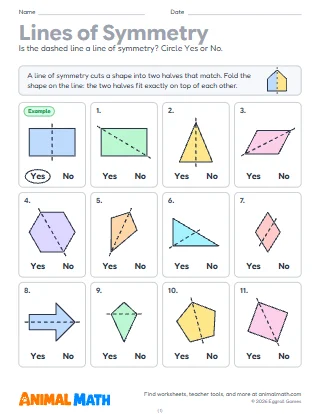
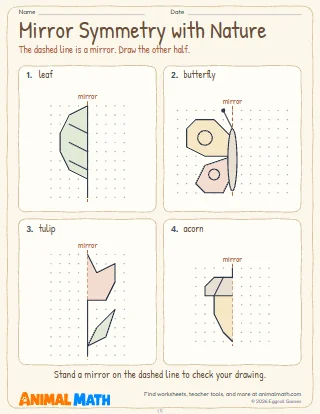
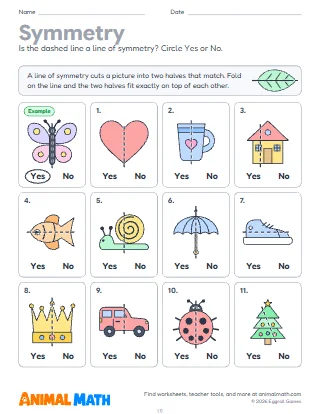
Fold a paper square in half and cut a shape to show that both halves match, then hold a small mirror on the dashed line of a design. On pages 1 to 3, have students work square by square from the line outward: a square next to the line on one side matches the square next to it on the other side.
Look for symmetry in rangoli, flowers, leaves and windows, and ask where the line of symmetry is. Make a simple rangoli with rice, beans or chalk, then make the other half match. If your family celebrates Diwali, look at your rangoli together and count its lines of symmetry.
This pack supports the following Common Core State Standards for Mathematics:
© Copyright 2010. National Governors Association Center for Best Practices and Council of Chief State School Officers. All rights reserved.
Line symmetry with rangoli, the colorful floor designs made for Diwali, on a square grid and as round petal designs. Students complete rangoli across one and two lines of symmetry, draw every line of symmetry and decide whether a dashed line is a line of symmetry.
Tell us what to make next, or build your own with a worksheet maker.
This worksheet is free to download, print, copy, and hand out in your classroom or at home. You do not need to create an account, and there are no watermarks on the PDF.