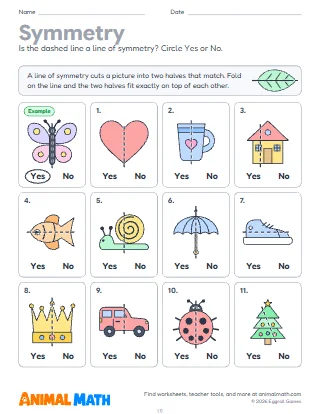
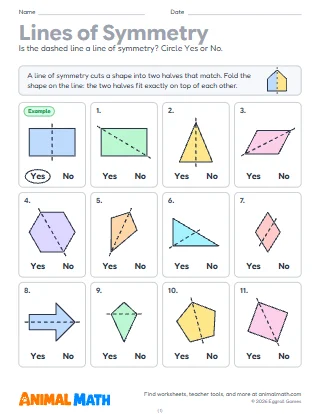
Five pages to do with a small mirror close by. Page 1 shows half of a leaf, a butterfly, a tulip and an acorn beside a dashed mirror line, on dot paper: children draw the other half, counting dots to place each corner. Page 2 shows nine pictures from nature, each with a dashed line, and children circle yes when the line is a line of symmetry and no when it is not. Page 3 has four loose-parts designs (pebbles, gems, leaves, acorns, shells, flowers and buttons) on one side of a mirror line on a grid, to copy onto the other side so each part sits as far from the mirror as the first one. Page 4 turns the mirror on its side: the pond reflects a tree, a mushroom, mountains and a flower, and children draw each reflection upside down in the water. Page 5 has two designs to copy into a pond and a large grid for children to make their own mirror design.
Set the pages out on an invitation table with small safe mirrors and a tray of real pebbles, leaves and shells. Let children stand a mirror on the dashed line before they draw, and look at how the half becomes a whole. On page 3, children can build each design with real loose parts first, then draw it. Photograph the designs children make on page 5, put them up with the children's own words about them, and ask: how do you know it matches?
Look for symmetry together: leaves, butterflies, faces, windows. Give your child a small mirror and let them stand it across pictures in a book. For page 3 and page 5, gather a few pebbles, buttons or leaves from home or outside and build the designs on the table before drawing them.
This pack supports the following Common Core State Standards for Mathematics:
© Copyright 2010. National Governors Association Center for Best Practices and Council of Chief State School Officers. All rights reserved.
Reggio-inspired symmetry pages to explore with a real mirror: leaves, butterflies, flowers, acorns, a pond that reflects the world, and designs made of loose parts. Children draw the other half on dot paper, decide whether a line is a line of symmetry, copy pebble and leaf designs across a mirror line, draw reflections in a pond and make a mirror design of their own.
Tell us what to make next, or build your own with a worksheet maker.
This worksheet is free to download, print, copy, and hand out in your classroom or at home. You do not need to create an account, and there are no watermarks on the PDF.