Snowflakes grow from tiny ice crystals high in the clouds. Water freezes into a six-sided shape, so most snowflakes have six arms, and a snowflake that grows evenly has six lines of symmetry. Ice crystals also grow as flat six-sided plates and as long columns, depending on how cold and damp the air is.
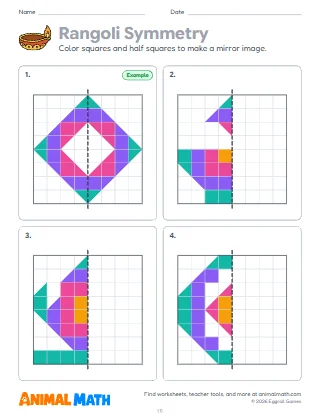
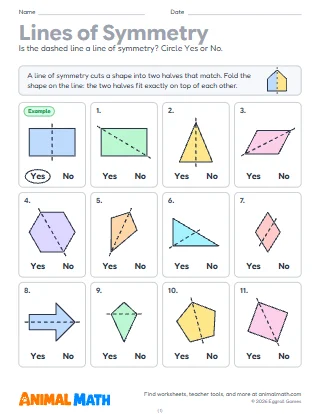
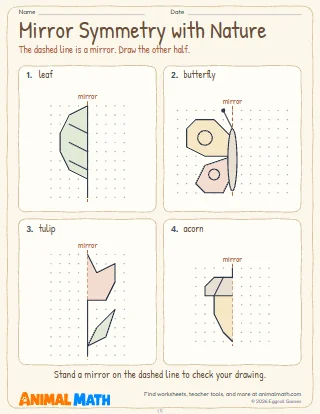
Six pages of line symmetry with snowflakes. Page 1 shows six snowflakes and ice crystals: draw every line of symmetry and write how many. Most have six, one with long and short arms has three, a column has two and a pinwheel has none. Page 2 shows eight snowflakes with a dashed line: circle Yes if it is a line of symmetry and No if it is not. Page 3 gives the left half of four snowflakes drawn on dot paper: draw the right half on the dots. Page 4 does the same on a square grid with squares and half squares, and page 5 gives one quarter of each snowflake to finish across both lines. Page 6 is for designing a snowflake of your own. The first problem on pages 1 to 5 is a worked example.
Fold a paper circle in half three times, cut small notches and open it to make a paper snowflake, then find its lines of symmetry by folding again. On the dot paper page, have students count the dots from the dashed line: a line that starts two dots to the left of it ends two dots to the right on the other side. Page 6 makes a good hallway display.
Catch snowflakes on a dark mitten or a cold sheet of black paper and look at them with a magnifying glass. Count the arms. Cut a paper snowflake together and ask your child how many ways it could be folded so the halves match.
This pack supports the following Common Core State Standards for Mathematics:
© Copyright 2010. National Governors Association Center for Best Practices and Council of Chief State School Officers. All rights reserved.
Line symmetry with snowflakes and ice crystals, from six-armed stars to plates and columns. Students draw and count lines of symmetry, decide whether a dashed line is one, finish snowflakes across one and two lines on dot paper and a square grid, and design their own.
Tell us what to make next, or build your own with a worksheet maker.
This worksheet is free to download, print, copy, and hand out in your classroom or at home. You do not need to create an account, and there are no watermarks on the PDF.