Loading preview...

Skills Covered

  • Count on from the bigger number
  • Turn-around facts
  • Adding zero; true or false
  • Doubles and near doubles to 20
  • Make a ten to add
  • Number bonds to 20
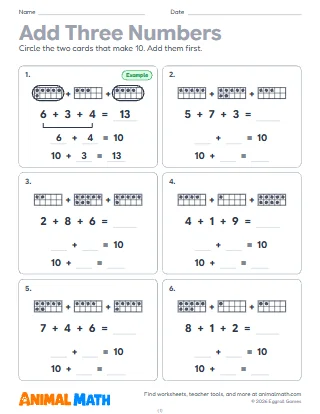
  • Add three numbers: a ten or a double first
  • Ways to make 20
  • Addition facts to 20
  • Add the same number to many numbers
  • Number puzzles to 20

How to Use This Pack

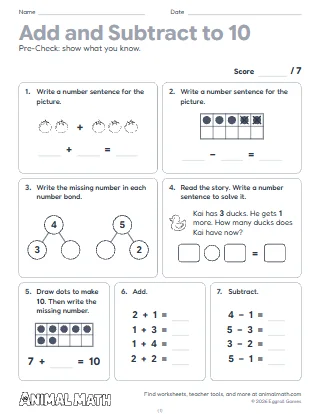
Seven pages for one unit on addition strategies to 20. Page 1 is a pre-check to give before the unit, to see what students already know; it stays within 10. Pages 2 and 3 are a review to do together before the test, with a tip on every question. Pages 4 and 5 are the unit test, Form A. Pages 6 and 7 are Form B: the same questions in the same order with different numbers, for a retake, a make-up or a second seating. Each form has 12 questions, one point each, and a Score line on its first page.

In the Classroom

Give the pre-check on the first day of the unit and sort the class by what they missed. Do the review the day before the test, reading the tips aloud. Many questions show the strategy as well as the answer (the numbers counted on, the double used, the ten made first), so look at the work as well as the sum. Question 10 is four quick facts: give the point when all four are right, or score them by the fact if you like. The answer keys name each question's skill, so a missed question points to the lesson to reteach.

At Home

Use the review as practice before a test at school, or Form B as a check after the unit. Read each question aloud with your child, and ask them to say how they found each sum.

Tips for Success

  • Read the questions aloud for students who are still learning to read
  • Ask students to say the double they used on the near doubles question
  • Keep a double ten frame on the desk for making a ten
  • On the three number question, any order works; the key shows the ten or double first
  • Use Form B as a retake after reteaching what was missed

Common Core Standards Alignment

This pack supports the following Common Core State Standards for Mathematics:

  • K.OA.A.3 Break a number up to 10 into two parts several ways, recording each as a picture or equation (7 = 3 + 4).
  • K.OA.A.4 For a number from 1 to 9, find the partner that adds with it to 10, and show it in a picture or number sentence.
  • 1.OA.A.2 Solve story problems where three numbers are added together for a total of 20 or less.
  • 1.OA.B.3 Use the order and grouping rules of addition as shortcuts, for example knowing 5 + 9 gives the same answer as 9 + 5.
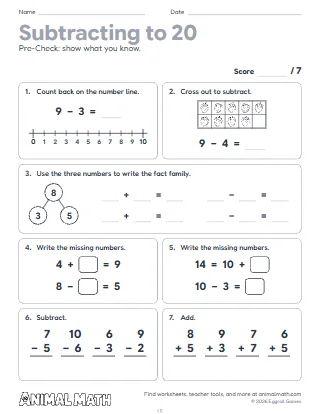
  • 1.OA.B.4 Treat subtraction as finding a missing addend: to solve 12 - 9, ask what added to 9 makes 12.
  • 1.OA.C.5 Connect counting with adding and subtracting, such as adding 4 by counting on four more.
  • 1.OA.C.6 Add and subtract to 20, working fluently within 10, with strategies like counting on, making ten, fact families and doubles plus one.
  • 1.OA.D.7 Know the equal sign means both sides have the same value, and decide whether addition and subtraction equations hold true.
  • 1.OA.D.8 Solve for the missing number in adding or subtracting equations like 9 + ? = 15 or ? - 4 = 6.

© Copyright 2010. National Governors Association Center for Best Practices and Council of Chief State School Officers. All rights reserved.

1st Grade Addition Strategies Test

1st Grade

A unit test for addition strategies to 20 in 1st grade: a one-page pre-check, a two-page review with a tip on every question, and the unit test in two forms (A and B) that ask the same questions with different numbers. Students count on from the bigger number, write turn-around facts, decide whether sentences with zero are true, add doubles and near doubles, make a ten to add, fill in number bonds to 20, add three numbers by finding a ten or a double, find ways to make 20, answer addition facts to 20, add the same number again, and finish a number puzzle. Answer keys name the skill and standard of every question.

Download PDF
Pin

What’s Included

  • A one-page pre-check (6 questions)
  • A two-page review with a tip on every question
  • The unit test in two forms, A and B (12 questions each)
  • Answer keys that name each question's skill and standard (14 pages in all)
Can’t find what you need?

Tell us what to make next, or build your own with a worksheet maker.

Suggest a worksheet

Free to print and share

This worksheet is free to download, print, copy, and hand out in your classroom or at home. You do not need to create an account, and there are no watermarks on the PDF.