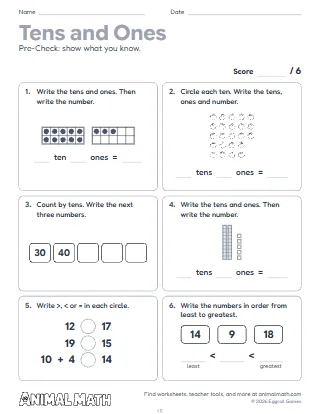
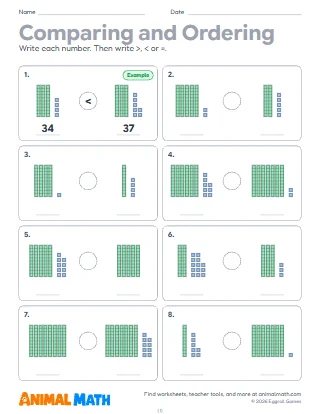
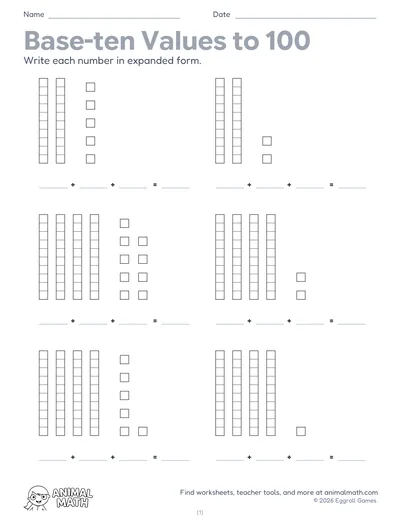
Twelve exit tickets, one for each lesson of a unit on tens and ones, in lesson order. Each page holds one lesson's ticket four times: copy the page, cut on the dashed lines, and seven copies give a class of 28 a ticket each. A ticket takes a few minutes at the end of the lesson. Students answer two or three questions, then circle a face beside the lesson's "I can" line to show how sure they feel.
Hand out the tickets in the last five minutes of the lesson and collect them at the door. Sort them into three piles (got it, almost, not yet) to plan tomorrow's small groups. The faces show how students feel about the lesson, the answers show what they can do; the two do not always agree. Ticket 7.6 (number words to 100) is for the states that teach it in 1st grade, Florida and Oklahoma; skip it if your class does not. The unit test is a separate pack.
Use a ticket as a quick check after practicing a skill together. Read the questions aloud, and ask your child how many tens and how many ones each number has.
This pack supports the following Common Core State Standards for Mathematics:
© Copyright 2010. National Governors Association Center for Best Practices and Council of Chief State School Officers. All rights reserved.
Exit tickets for every lesson of a 1st grade unit on tens and ones: one page a lesson, with the same ticket four times to copy and cut apart. Each ticket has two or three quick questions and ends with an "I can" line and three faces for students to rate themselves. Students circle groups of ten and trade ten ones for a ten, write teen numbers and decade numbers as tens and ones, read base-ten blocks, write numbers as tens plus ones, show one number more than one way, compare numbers with blocks and with >, < and =, put numbers to 120 in order, place numbers on a number line and sort numbers in a Venn diagram. Ticket 7.6 (number words to 100) is for the states that teach it in 1st grade. Answer keys for every ticket.
Tell us what to make next, or build your own with a worksheet maker.
This worksheet is free to download, print, copy, and hand out in your classroom or at home. You do not need to create an account, and there are no watermarks on the PDF.