Loading preview...

Features

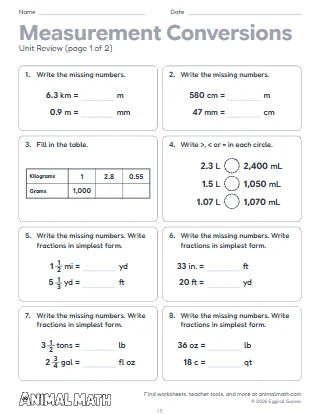
  • Forms A and B ask the same questions with different numbers
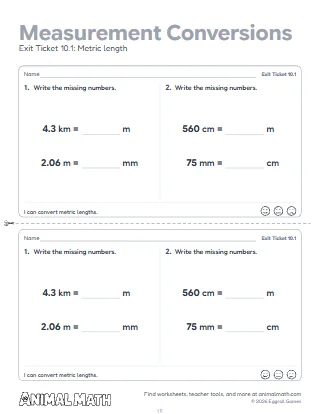
  • Convert metric lengths with decimals, from bigger units to smaller ones and back
  • A liters to milliliters table, and kilograms and grams compared with >, < and =
  • Convert customary lengths with fractions, both ways
  • Tons to pounds and gallons to fluid ounces, then ounces to pounds and pints to gallons
  • Two multi-step conversion stories
  • The last three questions (units of time and elapsed time, choosing a metric estimate and reading a beaker, measuring to the sixteenth inch and millimeter) are for the states that teach them in 5th grade
  • Answer keys name the lesson and skill of every question

Skills Covered

  • Metric length with decimals
  • Metric mass and liquid volume
  • Customary length with fractions
  • Tons, pounds and ounces; gallons to fluid ounces
  • Multi-step conversion stories
  • Weeks to seconds and elapsed time
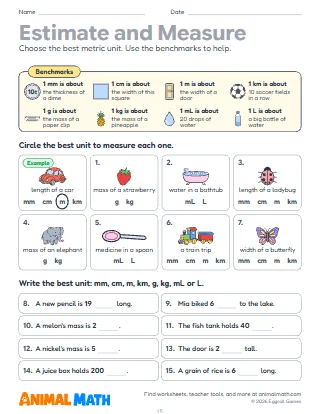
  • Choose a metric estimate and read a beaker
  • Measure to the nearest sixteenth inch and millimeter

How to Use This Pack

The unit test on measurement conversions. Pages 1 and 2 are Form A. Pages 3 and 4 are Form B: the same questions in the same order with different numbers, for a retake, a make-up or a second seating. Each form has 13 questions, one point each, and a Score line on its first page. Questions 1 to 10 are the Common Core part of the unit; questions 11 to 13 (units of time and elapsed time, choosing a metric estimate and reading a beaker, and measuring to the nearest sixteenth inch and millimeter) are for the states that teach them in 5th grade. No question asks a problem from the unit's exit tickets or the practice sheets. The pre-check and the unit review are packs of their own.

In the Classroom

Give Form A the day after the unit review. Most questions have two or more parts: give the point when every part is right, or score them by the part if you like. The rulers on question 13 are at real size, so print at 100% (not "fit to page") if your class will measure. Questions 11 to 13 are taught in 5th grade in some states only: give the ones your class learns and score out of what you give. The answer keys name each question's skill and show the work for the stories, so a missed question points to the lesson to reteach.

At Home

Use Form B as a check after the unit. Ask your child how many grams are in 2.5 kilograms, how many feet are in 1 1/3 yards, and how they know.

Tips for Success

  • Have students write the fact first (1 km = 1,000 m) before a conversion
  • A bigger unit takes fewer of itself: multiply to go to a smaller unit, divide to go to a bigger one
  • Metric conversions move the decimal point: 4.7 km is 4,700 m
  • In a story, change every amount to the unit the question asks for before adding or taking away
  • Use Form B as a retake after reteaching what was missed

Common Core Standards Alignment

This pack supports the following Common Core State Standards for Mathematics:

  • 4.MD.A.1 Know how units within one system compare, rewrite a measurement in a smaller unit, and make two-column conversion tables, like yards to feet.
  • 5.MD.A.1 Change measurements between bigger and smaller units of one system, such as 250 cm to 2.5 m, and use this in multi-step real-life problems.

© Copyright 2010. National Governors Association Center for Best Practices and Council of Chief State School Officers. All rights reserved.

5th Grade Measurement Conversions Test

5th Grade

The unit test on measurement conversions in two forms, from metric units with decimals to customary units with fractions and multi-step stories. Students convert length, mass, liquid volume, weight and capacity both ways, fill in a table, compare amounts in two units and solve conversion stories.

Download PDF
Pin

What’s Included

  • The unit test in two forms, A and B (13 questions each)
  • Answer keys that name each question's lesson and skill (8 pages in all)
Can’t find what you need?

Tell us what to make next, or build your own with a worksheet maker.

Suggest a worksheet

Free to print and share

This worksheet is free to download, print, copy, and hand out in your classroom or at home. You do not need to create an account, and there are no watermarks on the PDF.