Loading preview...

Features

  • Two quick questions a ticket
  • An "I can" line and three faces for students to rate themselves
  • Multiply multiples of 10, 100 and 1,000, and write powers of ten with exponents
  • Round each factor to estimate, and decide whether an answer is reasonable
  • Fill in area models and break a factor apart into partial products
  • Multiply with the standard algorithm, up to 3-digit by 3-digit numbers and zeros in a factor
  • Solve one-step and two-step multiplication stories
  • Answer keys for every ticket

Skills Covered

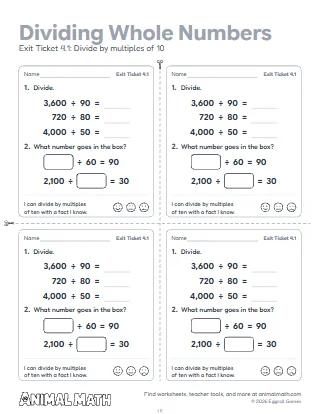
  • Multiply multiples of 10, 100 and 1,000
  • Powers of ten with exponents
  • Estimate a product by rounding
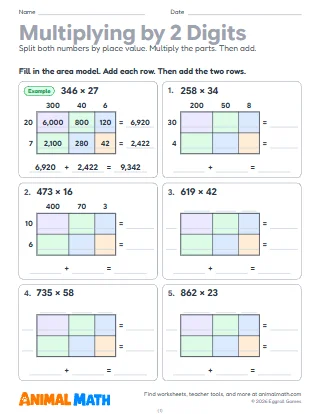
  • 2-digit times 2-digit in an area model
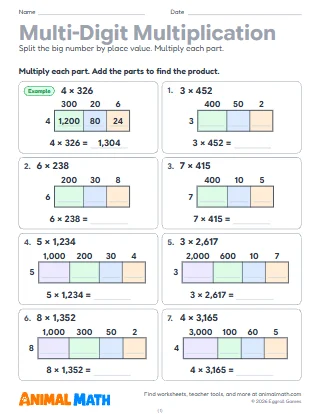
  • Partial products
  • 3-digit times 2-digit in an area model
  • The standard algorithm, 3 digits by 2 digits
  • 3-digit times 3-digit numbers
  • Zeros in a factor
  • One-step and two-step stories

How to Use This Pack

Seven exit tickets, one for each lesson of a unit on multiplying whole numbers, in lesson order. Each page holds one lesson's ticket four times: copy the page, cut on the dashed lines, and seven copies give a class of 28 a ticket each. A ticket takes a few minutes at the end of the lesson. Students answer two short questions, such as an area model to fill in, a problem in a column or a story, then circle a face beside the lesson's "I can" line to show how sure they feel.

In the Classroom

Hand out the tickets in the last five minutes of the lesson and collect them at the door. Sort them into three piles (got it, almost, not yet) to plan tomorrow's small groups. The keys show one way to work each story; other steps that reach the same answer are right too. The faces show how students feel about the lesson, the answers show what they can do; the two do not always agree. No ticket asks a problem from the practice sheets the lesson plans use.

At Home

Use a ticket as a quick check after practicing multiplication together. Ask your child to estimate first, then multiply, and to say whether the answer is close to the estimate.

Tips for Success

  • Think of 40 × 300 as 4 × 3 with three zeros after it
  • The exponent on a power of ten counts its zeros
  • Split a factor by place value, then add the partial products
  • The second row of the standard algorithm multiplies by the tens, so what it is worth ends in 0
  • Round each factor to its greatest place to check an answer

Common Core Standards Alignment

This pack supports the following Common Core State Standards for Mathematics:

  • 4.OA.A.3 Solve multi-step story problems with whole numbers and all four operations, deciding what remainders mean, writing equations with a letter, and checking by estimating.
  • 5.NBT.A.2 Explain why multiplying or dividing by 10, 100 or 1,000 adds zeros or moves the decimal point, and write powers of 10 with exponents.
  • 5.NBT.B.5 Multiply whole numbers with many digits fluently, using the standard written method.

© Copyright 2010. National Governors Association Center for Best Practices and Council of Chief State School Officers. All rights reserved.

5th Grade Multiplying Whole Numbers Exit Tickets

5th Grade

Exit tickets for every lesson of a unit on multiplying whole numbers, from multiples of 10, 100 and 1,000 to 3-digit by 3-digit products. Students fill in area models, multiply with the standard algorithm, estimate to check and solve stories, one quick ticket at the end of each lesson.

Download PDF
Pin

What’s Included

  • 7 exit tickets, one for each lesson of the unit
  • Each ticket four times on its page, to copy and cut apart
  • An "I can" line with three faces on every ticket
  • Answer keys for every ticket (14 pages in all)
Can’t find what you need?

Tell us what to make next, or build your own with a worksheet maker.

Suggest a worksheet

Free to print and share

This worksheet is free to download, print, copy, and hand out in your classroom or at home. You do not need to create an account, and there are no watermarks on the PDF.