Loading preview...

Features

  • Every lesson of the unit, in the order of the test
  • Count unit cubes, write a volume with its unit, and multiply the bottom layer by the layers
  • Use V = l × w × h and V = B × h, and add the volumes of two prisms
  • A volume story and a story with two boxes
  • The last four questions (faces, edges and vertices, nets, a missing edge, perimeter, area or volume) are for the states that teach them in 5th grade
  • Answer keys name the lesson and skill of every question

Skills Covered

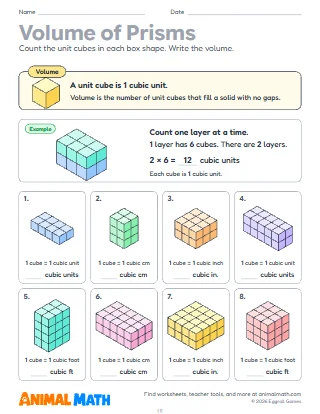
  • Volume as unit cubes, in cubic units
  • Cubic centimeters and cubic inches
  • The bottom layer times the number of layers
  • V = l × w × h and V = B × h
  • Shapes made of two prisms
  • Volume stories
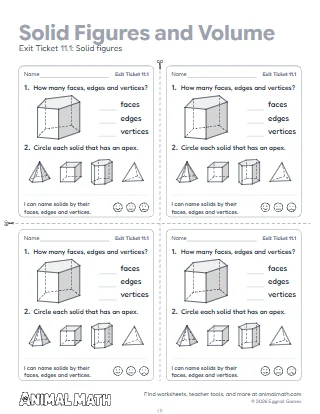
  • Faces, edges and vertices of solids
  • Nets of prisms and cubes
  • A missing edge, and a box with the same volume
  • Choosing perimeter, area or volume

How to Use This Pack

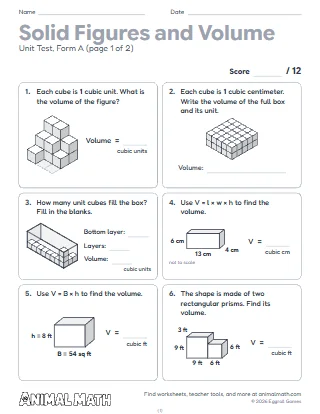
Two pages that go over the whole unit on solid figures and volume, to do together the day before the test. Its 12 questions take the lessons in the test's order, with other numbers; where the test counts a pyramid's faces and folds a prism's net, the review uses a prism and a pyramid's net, and its perimeter, area or volume story asks for a perimeter. Questions 1 to 8 are the Common Core lessons, and questions 9 to 12 are for the states that teach them. There is no Score line: it is practice, not a grade. The pre-check and the unit test are packs of their own.

In the Classroom

Do the review together the day before the test. Work a question, then let students try the next one on their own, and stop on any that trip up more than a few. Questions 9 to 12 are taught in 5th grade in some states only: leave out the ones your class does not learn. Where the key says "One way", other answers are right too. The keys name each question's lesson, so a question the class misses points to the lesson to go back to.

At Home

Use the review as practice before a test at school. Ask your child to say each formula in words before using it, and to label each volume with its unit.

Tips for Success

  • Count the bottom layer first, then the layers
  • Say each formula in words before putting in the numbers
  • Label every volume with its unit
  • Ask "around, cover or fill?" before a perimeter, area or volume story
  • Go back to the lesson the key names for a question the class misses

Common Core Standards Alignment

This pack supports the following Common Core State Standards for Mathematics:

  • 4.MD.A.3 Solve real and math problems with rectangle area and perimeter formulas, such as finding an unknown side from the area and the other side.
  • 5.NF.B.4b Tile a rectangle with fraction side lengths using squares whose sides are unit fractions, and see the area equals the two sides multiplied.
  • 5.MD.C.3a Know that a unit cube, with edges 1 unit long, has a volume of one cubic unit and is the unit for measuring volume.
  • 5.MD.C.3b Know that a solid exactly filled by some number of unit cubes, with no gaps or overlapping, has that many cubic units of volume.
  • 5.MD.C.4 Find a volume by counting how many unit cubes fill it, in cubic centimeters, inches, feet or made-up units.
  • 5.MD.C.5a Pack a rectangular prism with unit cubes and check that the cube count equals length × width × height, or base area × height.
  • 5.MD.C.5b Use the two volume formulas for rectangular prisms (length × width × height, and base area × height) in real and math problems.
  • 5.MD.C.5c Find the volume of a solid made of two rectangular prisms that do not overlap by adding their volumes, including in real problems.

© Copyright 2010. National Governors Association Center for Best Practices and Council of Chief State School Officers. All rights reserved.

5th Grade Solid Figures and Volume Unit Review

5th Grade

A review of the unit on solid figures and volume, to go over together the day before the test. Students count unit cubes, multiply layers, use the volume formulas, add the volumes of two prisms, solve stories, and work with solids, nets and missing edges.

Download PDF
Pin

What’s Included

  • A two-page review of every lesson in the unit (12 questions)
  • Answer keys that name each question's lesson and skill (4 pages in all)
Can’t find what you need?

Tell us what to make next, or build your own with a worksheet maker.

Suggest a worksheet

Free to print and share

This worksheet is free to download, print, copy, and hand out in your classroom or at home. You do not need to create an account, and there are no watermarks on the PDF.