Loading preview...

Skills Covered

  • Find the area and perimeter of a shape
  • Use square units for area and units for perimeter
  • Find both for rectangles with side lengths
  • Compare rectangles with the same perimeter
  • Draw rectangles with a given area or perimeter
  • Choose area or perimeter for a real job

How to Use This Pack

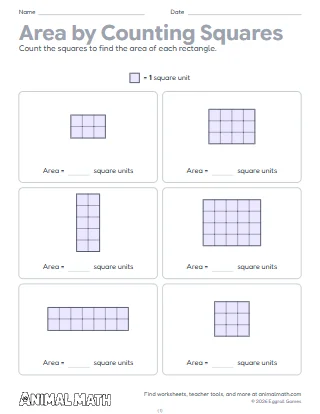
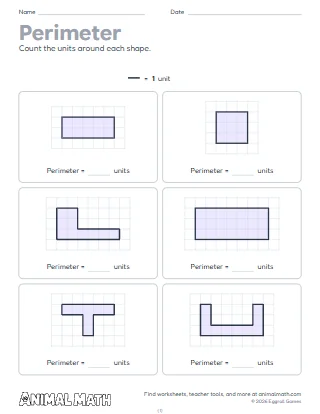
Five pages that put area and perimeter side by side, so students learn to tell them apart. Pages 1 and 2 find both measures, first for shapes on a grid and then for rectangles with side lengths. Page 3 shows pairs of rectangles with the same perimeter and different areas. Page 4 has students draw two rectangles with a perimeter of 12 units, then two with an area of 12 square units. Page 5 lists ten everyday jobs to sort into area or perimeter.

In the Classroom

Give pairs of students 12 square tiles and ask for every rectangle they can build; record the perimeters on the board. Then use string loops of the same length to make rectangles with different areas, which sets up pages 3 and 4.

At Home

Ask which measure fits a job around the house: covering a table with a cloth (area) or putting tape around its edge (perimeter).

Tips for Success

  • Area counts the squares inside; perimeter counts the units around
  • Area is in square units; perimeter is in units
  • Rectangles can share a perimeter and still have different areas
  • Cover or fill means area; around or edge means perimeter

Common Core Standards Alignment

This pack supports the following Common Core State Standards for Mathematics:

  • 3.MD.C.5a Know that a square with 1-unit sides has an area of one square unit and can be used to measure area.
  • 3.MD.C.5b Know that a flat shape exactly covered by some number of unit squares, with no spaces or overlapping, has that many square units of area.
  • 3.MD.C.6 Find an area by counting how many unit squares cover it, in square centimeters, meters, inches, feet or made-up units.
  • 3.MD.C.7a Tile a rectangle with whole-number sides and show that the number of tiles matches multiplying its length by its width.
  • 3.MD.C.7b Multiply length by width to get the area of whole-number rectangles in story and math problems, and picture products as rectangles.
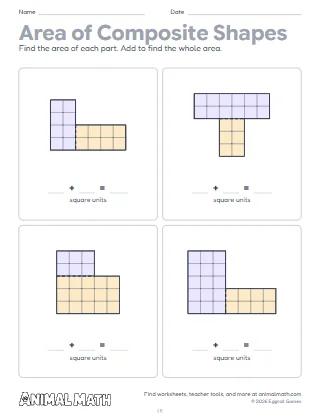
  • 3.MD.C.7c Use tiles or area models to show that splitting a rectangle's side into two parts splits its area into two products (the distributive property).
  • 3.MD.D.8 Solve perimeter problems for polygons: add side lengths, find a missing side, and compare rectangles with equal perimeters but different areas, or the reverse.

© Copyright 2010. National Governors Association Center for Best Practices and Council of Chief State School Officers. All rights reserved.

Area and Perimeter

Grade 3rd

A 5-page area and perimeter pack for 3rd grade. Find both for shapes on a grid and for labelled rectangles, compare rectangles with the same perimeter but different areas, draw rectangles with a given perimeter or area, and decide whether a job needs area or perimeter. Answer keys included.

Download PDF

What’s Included

  • 5 worksheets, each with a matching answer key (10 pages)
  • Area and perimeter of grid shapes and labelled rectangles
  • Same perimeter, different area comparisons and draw-your-own rectangles
  • An area-or-perimeter sorting page with ten real jobs
Can’t find what you need?

Tell us what to make next, or build your own with a worksheet maker.

Suggest a worksheet

Free to print and share

This worksheet is free to download, print, copy, and hand out in your classroom or at home. You do not need to create an account, and there are no watermarks on the PDF.