The bowl game, or peach stone game, is a Haudenosaunee game played at Midwinter and at other times of the year. Six peach stones, ground flat and darkened on one side, are shaken in a wooden bowl, and the players count how many land the same color up, keeping score with beans. Scoring rules differ from one community and one account to another, so these pages give no points: they only count how many dark sides land up, which is all the math needs.
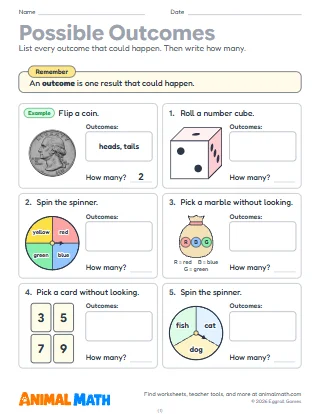
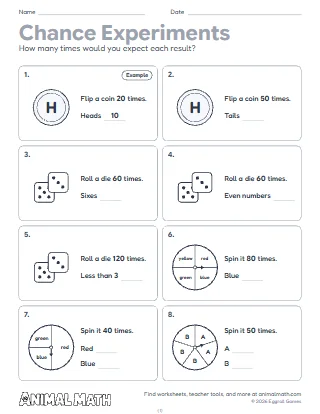
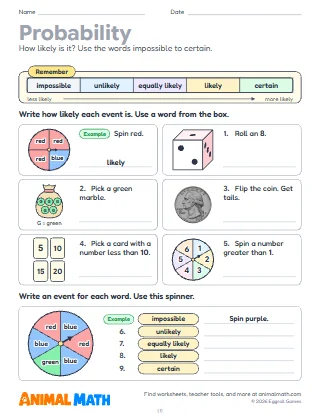
Five pages of data and chance. Page 1 counts the dark sides in nine shakes of the bowl and lists every count six stones can show. Page 2 tallies a class's 40 shakes in a frequency table and answers four questions. Page 3 follows a tree to every way two stones can land, writes each chance as a fraction, and names six events certain, likely, unlikely or impossible. Page 4 lists all 8 ways three stones can land and compares a class's 40 shakes with the number expected. Page 5 draws a bar graph of 50 shakes of six stones and reads it. The first problem of each kind is a worked example.
Make stones from coins, two-color counters or buttons marked on one side, and let pairs shake 2, then 3, then 6 in a bowl. Pool the class's results and compare them with pages 4 and 5: the more shakes, the closer the results come to what is expected.
Shake two coins 20 times and tally how many land heads up. Do you get 1 head about half the time, as the tree on page 3 says?
This pack supports the following Common Core State Standards for Mathematics:
© Copyright 2010. National Governors Association Center for Best Practices and Council of Chief State School Officers. All rights reserved.
Data and chance from the Haudenosaunee bowl game, where six peach stones, dark on one side, are shaken in a wooden bowl. Students count dark sides, tally a class's shakes, list every way two and three stones can land, compare results with what is expected and draw a bar graph.
Tell us what to make next, or build your own with a worksheet maker.
This worksheet is free to download, print, copy, and hand out in your classroom or at home. You do not need to create an account, and there are no watermarks on the PDF.