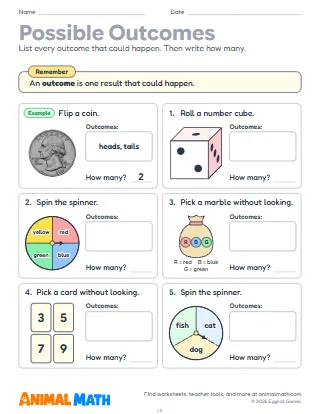
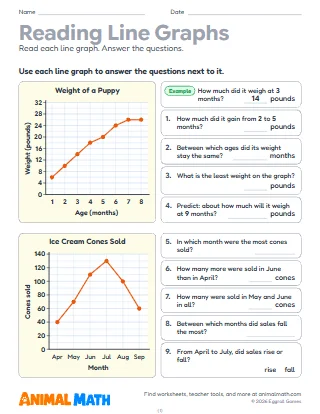
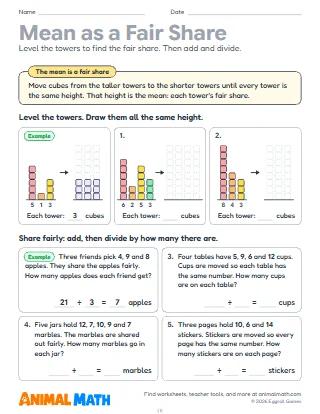
Five pages on how likely an event is, in words and as a number. Page 1 has a strip of the five likelihood words, six events with spinners, a bag, a number cube, cards and a coin to name (impossible, unlikely, equally likely, likely or certain), and one spinner to write an event for each word. Page 2 explains probability as the number of ways an event can happen over the number of possible outcomes, writes six probabilities as fractions with spinners, a number cube, a bag, cards and a coin, then six probabilities from 24 numbered cards, including 0 and 1. Page 3 writes three probabilities, marks each on a number line cut into as many parts as there are outcomes and names it, then places seven events from one spinner on a line of eighths. Page 4 finishes two tree diagrams and a chart of 18 outcomes and finds probabilities from them, then multiplies to count outcomes, such as 3 shirts and 4 pairs of pants. Page 5 writes letters on spinners, marbles and tiles and numbers on a cube so given probabilities are true, then writes probability stories for 2/3 and 0.
Start with a paper bag and a few colored cubes. Put in 3 red cubes and 1 blue cube and ask how likely red is, then what fraction of the cubes are red. Move the cubes around and ask again before page 2. For page 4, have pairs flip a coin and spin a paper spinner, writing each outcome on a sticky note, then sort the notes into a tree on the board. Page 5 works well as a swap: students trade their stories and solve each other's.
Play a board game with a number cube and ask how likely it is to roll a 6, then what the probability is as a fraction. Put socks of two colors in a drawer and ask about the chance of pulling out each color. Count outfits together: how many shirt and pants pairs can your child make, and does multiplying give the same number?
This pack supports the following Common Core State Standards for Mathematics:
© Copyright 2010. National Governors Association Center for Best Practices and Council of Chief State School Officers. All rights reserved.
A 5-page probability pack for 4th and 5th grade. Say how likely events with spinners, bags of marbles, number cubes, cards and a coin are, from impossible through unlikely, equally likely and likely to certain, and write an event for each word. Write probabilities as fractions from 0 to 1 with up to 24 outcomes, and mark them on number lines where impossible is 0, equally likely is 1/2 and certain is 1. List sample spaces in tree diagrams and a chart, find the probability of an outcome, and multiply to count outcomes (3 shirts and 4 pants make 12 outfits). Then make spinners, marbles, tiles and a number cube that fit given probabilities, and write probability stories. Every page comes in color and in black and white. Answer keys included.
Tell us what to make next, or build your own with a worksheet maker.
This worksheet is free to download, print, copy, and hand out in your classroom or at home. You do not need to create an account, and there are no watermarks on the PDF.