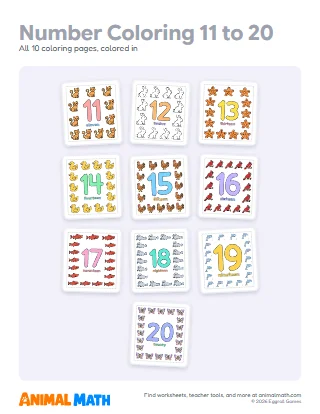
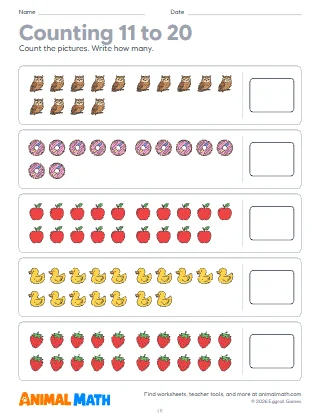
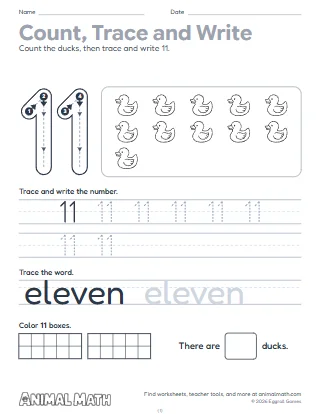
Ten pages, one for each number from 11 to 20, and each page goes from big to small and from more help to less. The start dots count on across the number: on 14 the 1 is strokes 1 and 2 and the 4 is strokes 3, 4 and 5, so children always write the 1 first. The top row has big bubble numbers with the dots and arrows, the next row has the dots and a dashed line down the middle, and the row after that has only the start dots. At the bottom, handwriting lines hold an example, numbers to trace and room to write.
Before each page, say the number and what it is made of: "Fourteen is ten and four, so we write a 1, then a 4." Trace the big number with a finger together, then with a crayon. The pages work as a teen number a day, or give a child the page for a number they write backwards, such as 41 for 14.
Say the number together, then trace it. Ask your child which digit they write first. Find teen numbers on a calendar, a clock or a page number and read them together.
This pack supports the following Common Core State Standards for Mathematics:
© Copyright 2010. National Governors Association Center for Best Practices and Council of Chief State School Officers. All rights reserved.
Big bubble numbers from 11 to 20, one number a page, with numbered start dots that count on from the first digit to the second. Children trace inside the bubbles with a little less help on every row, then write the number on handwriting lines.
Tell us what to make next, or build your own with a worksheet maker.
This worksheet is free to download, print, copy, and hand out in your classroom or at home. You do not need to create an account, and there are no watermarks on the PDF.