Diwali, the festival of lights, is celebrated by Hindus, Jains and some Buddhists around the world, with different meanings and traditions, and Sikhs celebrate Bandi Chhor Divas at the same time. Many families light rows of small clay lamps called diyas, decorate with rangoli and marigolds, and share sweets. It falls in October or November and is often celebrated over several days; in 2026 the main day is November 8.
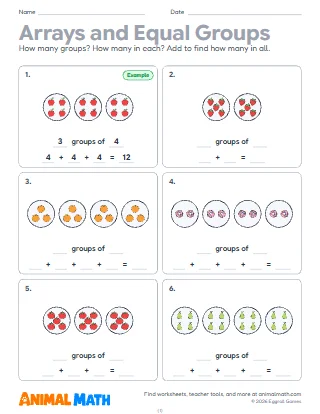
Five pages of arrays with no times sign, all as repeated addition. Page 1 shows diyas, marigolds and laddoo sweets in rows: write how many rows and how many in each row, then add the rows, such as 4 + 4 + 4 = 12. Page 2 adds each array by its rows and then by its columns, and both give the same total. Page 3 shows an array beside three additions to circle the one that matches; the others have a row too many or too few. Page 4 asks students to draw arrays, from words (3 rows of 5 diyas) and from sums (3 + 3 + 3). Page 5 has six Diwali array stories, such as 3 rows of 4 diyas on the steps: draw the array, write the addition and the total. Each page starts with a worked example.
Set out counters or paper diyas in 3 rows of 4 and have half the class add the rows and half add the columns. Compare the totals. Turn the array a quarter turn and ask whether the total changes. Students can make a class Diwali display of paper diyas in an array and write its addition underneath.
Look for arrays at home: an egg carton, a muffin pan, a tray of sweets, a row of lights. Ask how many rows, how many in each row and how many in all, and add the rows aloud together.
This pack supports the following Common Core State Standards for Mathematics:
© Copyright 2010. National Governors Association Center for Best Practices and Council of Chief State School Officers. All rights reserved.
Arrays of diya lamps, marigolds and sweets up to 5 rows and 5 columns, written as repeated addition. Students add arrays by rows and by columns, pick the addition that matches an array, draw arrays and solve Diwali array stories.
Tell us what to make next, or build your own with a worksheet maker.
This worksheet is free to download, print, copy, and hand out in your classroom or at home. You do not need to create an account, and there are no watermarks on the PDF.