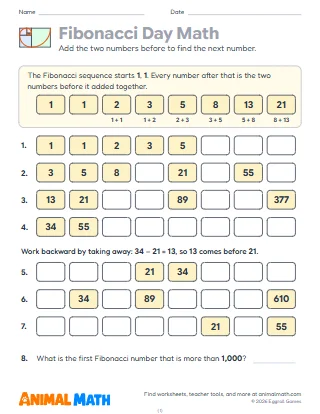
Fibonacci Day is November 23, written 11/23 in the United States: 1, 1, 2, 3, the first Fibonacci numbers. It celebrates Leonardo of Pisa, called Fibonacci, whose book of 1202 taught Europe to calculate with the digits 0 to 9 and asked the famous puzzle about rabbits.
Six pages that bring poetry to Fibonacci Day. Page 1 tells who Leonardo of Pisa was and how the digits 0 to 9 reached Europe, and page 2 his rabbit puzzle, where each number is the sum of the two before it; each has four questions. Page 3 has two short Fib poems to read aloud and clap: their lines have 1, 1, 2, 3, 5 and 8 syllables. Page 4 asks how many syllables a dozen words have. On page 5 children write a Fib of their own, ticking a circle for each syllable, and draw it, and page 6 is a longer Fib that adds a line of 13.
Clap the syllables of children's names together before page 3, then read the two Fibs aloud and clap them line by line. Write a class Fib on the board before page 5. Pair the pack with our Fibonacci Day Math for the numbers themselves.
Read the Fibs aloud together and clap the beats. Then take turns adding a line to a family Fib about your day.
Who Fibonacci was, his rabbit puzzle, and Fib poems, whose lines have 1, 1, 2, 3, 5 and 8 syllables. Children read about Leonardo of Pisa, count syllables, then write Fibs of their own.
Tell us what to make next, or build your own with a worksheet maker.
This worksheet is free to download, print, copy, and hand out in your classroom or at home. You do not need to create an account, and there are no watermarks on the PDF.