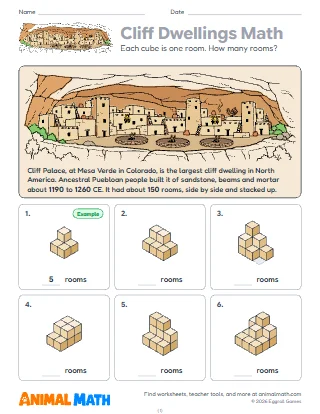
Native nations have built homes in many shapes, each suited to its land. Many Diné (Navajo) hogans have six or eight sides, with the door facing east, and Diné builders still build them today. Haudenosaunee longhouses, about 20 feet wide and up to 200 feet long, were home to several families of one clan, and longhouses are still built as gathering places. The Mandan, Hidatsa and Arikara built round earth lodges, 30 to 60 feet across, along the Missouri River. Ancestral Puebloans built Cliff Palace, with 150 rooms, in what is now Mesa Verde National Park about 800 years ago, and Pueblo people still live in stacked homes at Taos Pueblo. The figures come from the park service, Ganondagan State Historic Site and UNESCO; the side lengths in the perimeter problems are story numbers.
Five pages of 2nd and 3rd grade geometry. Page 1 shows six homes with their floor plans: students name each shape and count its sides and vertices. Page 2 has six floor plans to copy on dot paper, then count the sides. Page 3 finds the perimeter of six floor plans in feet; the last gives the perimeter and asks for the missing side. Page 4 counts the rooms, windows, ladders and the sides of the T-shaped doorway in a pueblo wall. Page 5 fills in a table of the floors and compares them. The first problem on pages 1 to 4 and the first table row are worked examples.
Before page 1, show photos of a hogan, a longhouse, an earth lodge and Taos Pueblo, and talk about what a floor plan is. On page 2, have students trace each side with a finger as they count. On page 3, ask why the hogan floors need only one side labelled.
Draw the floor plan of a room in your home together. What shape is it? How many sides and vertices does it have? Pace out its sides and add them up.
This pack supports the following Common Core State Standards for Mathematics:
© Copyright 2010. National Governors Association Center for Best Practices and Council of Chief State School Officers. All rights reserved.
Geometry from the homes of four Native nations: the Diné hogan, the Haudenosaunee longhouse, the earth lodge and the pueblo. Students name the shapes of floor plans, count sides and vertices, copy plans on dot paper, find perimeters and count the shapes in a pueblo wall.
Tell us what to make next, or build your own with a worksheet maker.
This worksheet is free to download, print, copy, and hand out in your classroom or at home. You do not need to create an account, and there are no watermarks on the PDF.