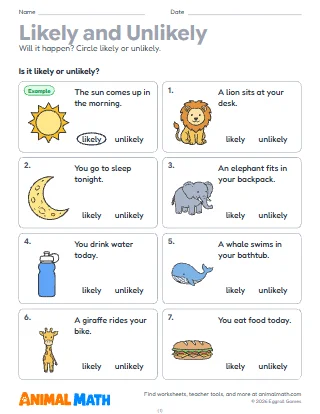
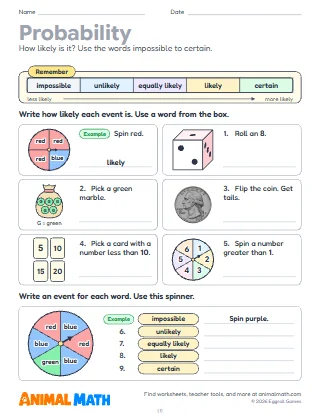
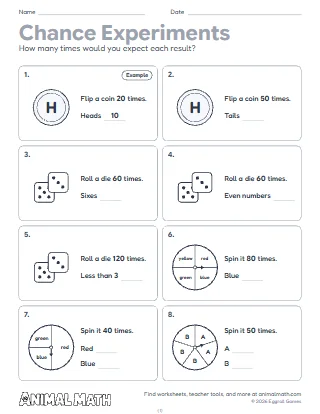
Five pages about how likely an event is, from impossible to certain, with spinners, bags of counters and number cubes. A color key at the top of every page shows the pattern each color has on the black-and-white copies. Page 1 names six events impossible, possible or certain, then four everyday events certain or uncertain. Page 2 shows an event and its opposite (spin red, do not spin red), asks how likely each one is, and which is more likely, or whether they are equally likely. Page 3 places six events from one spinner on a likelihood line by counting the parts that match, then puts four picks from a bag in order from least likely to most likely. Page 4 compares two events on one spinner, bag or cube, then chooses which of three spinners or bags gives the best chance. Page 5 asks students to write color letters on blank spinners and bags so that sentences such as "Blue is impossible. Red is more likely than green." are true.
Hold up a paper bag with 3 red cubes and 1 blue cube. Ask students to name an event that is certain, one that is impossible and one that is possible, then the opposite of each. Draw a long likelihood line on the board, from impossible to certain, and let students tape event cards on it, explaining where each goes. Before page 4, spin a real spinner 20 times and tally the results: did the color with more parts come up more often?
Play a board game with a number cube and talk about the next roll: is rolling a 7 possible? Is rolling a number less than 7 certain? What is the opposite of rolling a 6? Fill a bag with socks of two colors and ask your child to change what is in it so that one color is certain, then impossible, then equally likely.
This pack supports the following Common Core State Standards for Mathematics:
© Copyright 2010. National Governors Association Center for Best Practices and Council of Chief State School Officers. All rights reserved.
How likely an event is, in words from impossible to certain, with spinners, bags of counters and number cubes. Students name events and their opposites, compare them, place them on a likelihood line, choose the best spinner or bag, and make their own to match.
Tell us what to make next, or build your own with a worksheet maker.
This worksheet is free to download, print, copy, and hand out in your classroom or at home. You do not need to create an account, and there are no watermarks on the PDF.