Loading preview...

Features

  • Every lesson of the unit, in the same kinds of question as the test
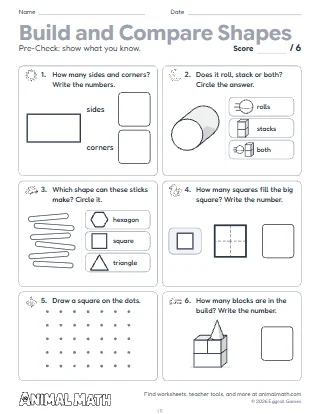
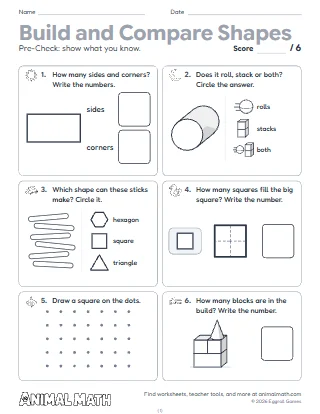
  • Count the sides and corners of a triangle, circle every round shape, and say whether a cube rolls, stacks or both
  • Find the shape a pile of sticks can make, draw a rectangle on dot paper, find the two shapes that make a hexagon, and count the squares that fill a rectangle
  • The last question (count the blocks in a build) is for Oklahoma, which teaches building with blocks
  • A small picture beside each question number, so the teacher can say "find the sun"
  • Answer keys name the lesson and skill of every question

Skills Covered

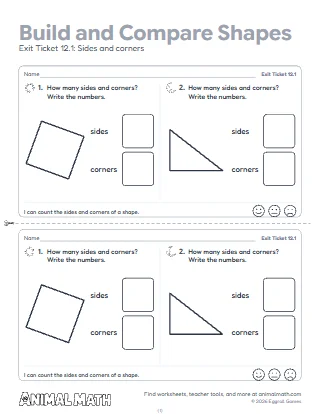
  • Count the sides and corners of a shape
  • Find the shapes that are alike: 4 sides, or round
  • Tell which solids roll, stack or both
  • Find the shape a set of sticks can make
  • Draw a shape on dot paper
  • Find the two shapes that make a bigger shape
  • Count the pieces that fill an outline
  • Count the blocks in a build

How to Use This Pack

Two pages that go over the whole unit on building and comparing shapes, to do together the day before the test. Its 8 questions are the same kinds as the test's, in the same order, with other shapes and builds, so nothing on the review is on the test. Read every question aloud: a small picture beside each question number (a sun, a moon, a car) lets you say "Find the sun. How many sides and corners?" There is no Score line: it is practice, not a grade. The pre-check and the unit test are packs of their own.

In the Classroom

Do the review together the day before the test, with sticks, pattern blocks or a few solid shapes out. Read a question, let children answer on their own, and stop on any that trip up more than a few. On question 5 any rectangle drawn on the dots is right, as long as its sides are straight and meet at the corners. Question 8 (count the blocks in a build) is taught in Kindergarten in Oklahoma: skip it if your class does not learn it. The keys name each question's lesson, so a question the class misses points to the lesson to go back to.

At Home

Use the review as practice before a test at school. Read each question aloud, and let your child build the shapes with sticks, straws or blocks before answering.

Tips for Success

  • Read every question aloud; children answer by circling, writing one number or drawing
  • Say the picture first: "Find the moon," then the question
  • Name each choice as you point to it, so no child has to read a word
  • Let children touch each side and corner as they count
  • Go back to the lesson the key names for a question the class misses

Common Core Standards Alignment

This pack supports the following Common Core State Standards for Mathematics:

  • K.G.A.1 Use shape names for everyday objects, and tell where things are with position words like over, under, next to and behind.
  • K.G.A.2 Name shapes correctly even when they are turned, tilted, bigger or smaller.
  • K.G.A.3 Tell whether a shape is flat (two-dimensional) or solid (three-dimensional).
  • K.G.B.4 Compare flat and solid shapes of any size or position, using everyday words for their sides, corners and other features.
  • K.G.B.5 Make shapes seen in the world by drawing them or building them from parts such as straws and clay.
  • K.G.B.6 Put small shapes together to make bigger ones, such as joining triangles to make a square.
  • 1.G.A.2 Combine flat shapes (such as trapezoids and half-circles) or solids (such as cubes and cones) into a new shape, then build more shapes from it.

© Copyright 2010. National Governors Association Center for Best Practices and Council of Chief State School Officers. All rights reserved.

Kindergarten Build and Compare Shapes Unit Review

A read-aloud review of the unit on building and comparing shapes, to go over together the day before the test. Children count sides and corners, find round shapes, say whether a solid rolls or stacks, draw on dot paper, put two shapes together and fill an outline.

Download PDF
Pin

What’s Included

  • A two-page review of every lesson in the unit, to read aloud (8 questions)
  • Answer keys that name each question's lesson and skill (4 pages in all)
Can’t find what you need?

Tell us what to make next, or build your own with a worksheet maker.

Suggest a worksheet

Free to print and share

This worksheet is free to download, print, copy, and hand out in your classroom or at home. You do not need to create an account, and there are no watermarks on the PDF.