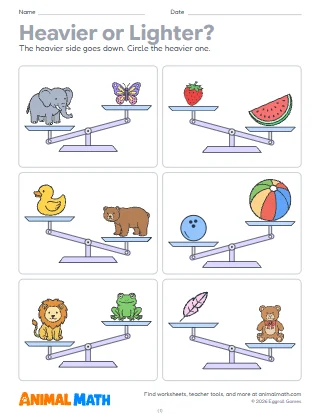
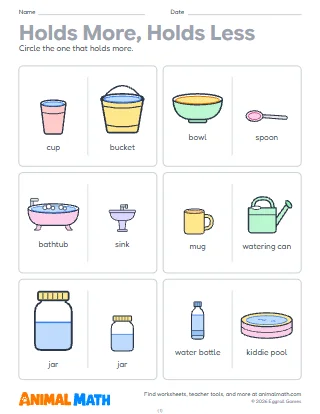
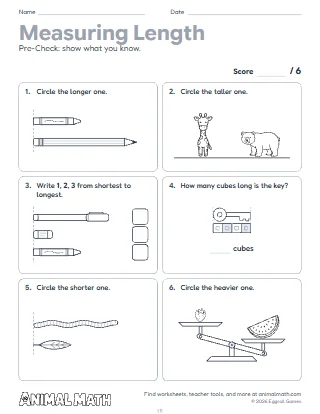
Five pages for Year 1 on measuring mass and capacity and starting to write the results down. Page 1 shows six level balances, each with a toy or a piece of fruit on one pan and cubes on the other: children count the cubes and write how many the thing weighs. On page 2 each balance has tipped, and children circle heavier or lighter to finish a sentence about one of the two things. Page 3 weighs four more things in cubes; children write each result in a table, then circle the heaviest and the lightest. Page 4 does the same for capacity: children count the cups of water that fill a bowl, a bottle, a jug and a watering can, fill in the table and circle the one that holds the most and the least. Page 5 moves on to standard units, with a kitchen scale in kilograms and a measuring jug marked in litres. The first problem on each page is a worked example.
Set up a pan balance with a basket of interlocking cubes and a few toys. Ask children to guess which toy is heavier, then check on the balance: the heavier side goes down. Weigh one toy in cubes together and write the result on the board before page 1. Fill a jug with cups of water or rice at the water tray before page 4, counting each cup out loud.
In the kitchen, hold two things, one in each hand, and ask which feels heavier. Count how many cups of water fill a saucepan or a jug, and look for the kilograms on a bag of flour or potatoes and the litres on a bottle of milk or juice.
This pack supports the following Common Core State Standards for Mathematics:
© Copyright 2010. National Governors Association Center for Best Practices and Council of Chief State School Officers. All rights reserved.
Measuring how heavy things are with a pan balance and how much containers hold with cups, then writing the results down. Students count the cubes that balance a toy, say heavier or lighter, count the cups that fill a jug, record both in tables and read a kitchen scale and a measuring jug.
Tell us what to make next, or build your own with a worksheet maker.
This worksheet is free to download, print, copy, and hand out in your classroom or at home. You do not need to create an account, and there are no watermarks on the PDF.