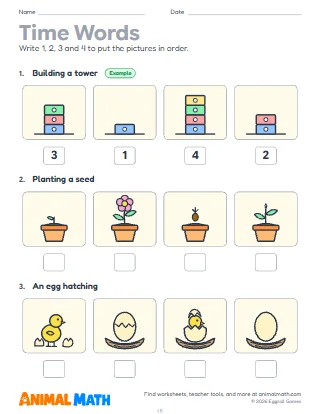
Six pages about the parts of a day, shown by three skies: the sun coming up for morning, the sun high in the sky for afternoon, and the moon and stars for night. On page 1 children circle the sky for when we do each thing, like waking up or looking at the stars, and on page 2 they draw a line from each picture to its sky. Page 3 shows three things from one day: children write 1, 2 and 3 to put them in order. Pages 4 and 5 compare how long two things take: circle the one that takes longer, then the one that takes less time. Page 6 has no one right answer: children draw something they do in the morning, the afternoon and at night. Every page but the last starts with a worked example.
Read the words under each picture aloud as you point to it. Before page 1, walk through your class's own day: what do we do when the sun comes up, after lunch, when it is dark? Lunch is the middle of the day: before lunch is the morning, after lunch is the afternoon. Before pages 4 and 5, time something short with a sand timer, like washing hands, and compare it with something long, like the whole school day.
At dinner, talk about the day: what did you do this morning, this afternoon, and what will you do tonight? Ask which takes longer, the trip to school or brushing your teeth.
This pack supports the following Common Core State Standards for Mathematics:
© Copyright 2010. National Governors Association Center for Best Practices and Council of Chief State School Officers. All rights reserved.
The parts of a day, morning, afternoon and night, and how long the things we do take. Children tell when we do everyday things, put the events of a day in order, circle which of two things takes longer or less time, and draw their own day.
Tell us what to make next, or build your own with a worksheet maker.
This worksheet is free to download, print, copy, and hand out in your classroom or at home. You do not need to create an account, and there are no watermarks on the PDF.