Five pages for Year 1 on the language of time and putting events in order. Page 1 shows three short picture stories, building a tower, planting a seed and an egg hatching, with the pictures muddled up: children write 1, 2, 3 and 4 to put them in order. On page 2 they look at one picture and circle what comes next or what came just before, or circle which of three pictures came first or last. Page 3 lists everyday things with an o'clock time and a clock, such as waking up at 7 o'clock or having a bath at 6 o'clock, and children circle morning, afternoon or evening. Page 4 shows the days of the week from Monday to Sunday; for each "Today is ..." children circle the day that was yesterday and the day that will be tomorrow, including Sunday to Monday. Page 5 asks who is quicker or slower, which takes longer, and which of two clocks shows the earlier or later time on one afternoon. The first problem on each page is a worked example.
Act out a short routine, such as getting ready for PE, and ask the class what you did first, next and last. Sing the days of the week each morning and ask what day it was yesterday and what day it will be tomorrow. Before page 5, race a toy car against a toy snail across the carpet and talk about which is quicker.
Talk through the day at bedtime: what did you do this morning, this afternoon and this evening? Ask what day it is today, what day it was yesterday and what day it will be tomorrow. Time two jobs, like brushing teeth and tidying a toy box, and ask which took longer.
This pack supports the following Common Core State Standards for Mathematics:
© Copyright 2010. National Governors Association Center for Best Practices and Council of Chief State School Officers. All rights reserved.
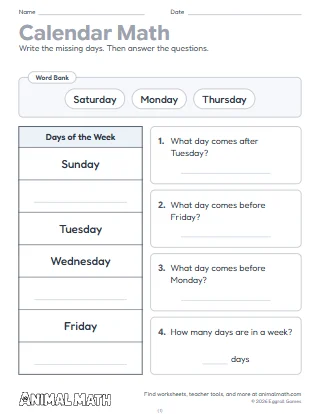
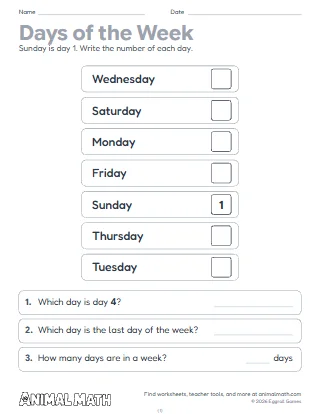
The words children use to talk about time: first, next, before, after, yesterday, today, tomorrow, morning, afternoon, evening, quicker, slower, earlier and later. Students put picture stories in order, choose what comes next or came before, sort everyday things into the morning, afternoon or evening, work out yesterday and tomorrow, and compare how long things take.
Tell us what to make next, or build your own with a worksheet maker.
This worksheet is free to download, print, copy, and hand out in your classroom or at home. You do not need to create an account, and there are no watermarks on the PDF.