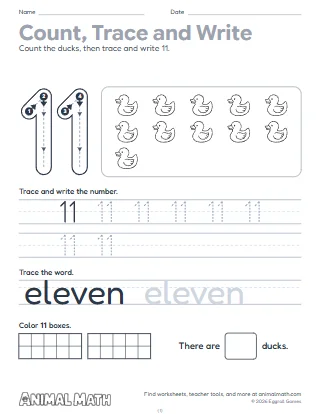
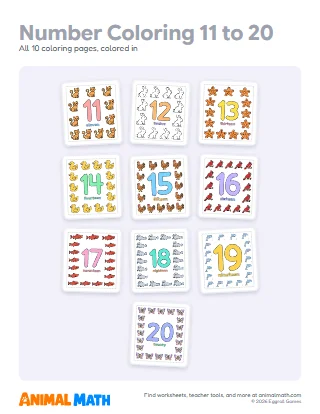
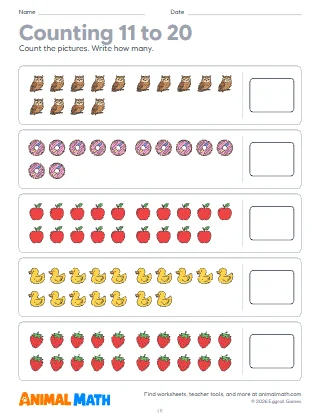
Ten pages, one for each number from 11 to 20. The number and its word sit at the top of the page, and six boxes look at it in different ways. Trace it has the number as dashed lines with numbered start dots that count on across both digits, and Color it is a big bubble number. Find it hides the number four times among others, such as its digits turned around (31 for 13) and the teen numbers near it. Count it asks children to color that many stars out of a few more, Show it to draw that many dots in two empty ten frames, and Write it has an example, two to trace and room to write. The answer keys circle every copy in Find it, color one way of picking the stars and draw the dots.
Read the number and its word together and say what it is made of: "Thirteen is ten and three." Do Show it as a class first, filling the first ten frame before the second. In Find it, talk about why 31 is not 13: the digit we write first matters.
Pick a number of the day and build it with small things: a group of ten and some more. Look for the number on a calendar or a clock and finish the page together.
This pack supports the following Common Core State Standards for Mathematics:
© Copyright 2010. National Governors Association Center for Best Practices and Council of Chief State School Officers. All rights reserved.
A page for each number from 11 to 20 that looks at it six ways, made for a number of the day routine. Children trace it, color it, find it among numbers that look like it, color that many stars, draw it in two ten frames and write it.
Tell us what to make next, or build your own with a worksheet maker.
This worksheet is free to download, print, copy, and hand out in your classroom or at home. You do not need to create an account, and there are no watermarks on the PDF.