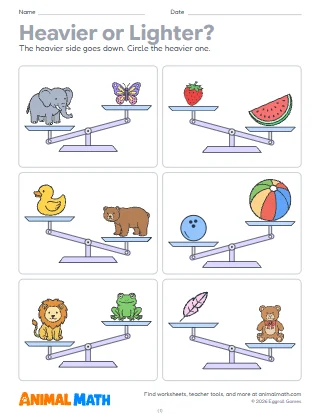
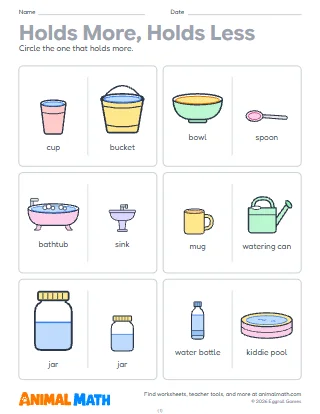
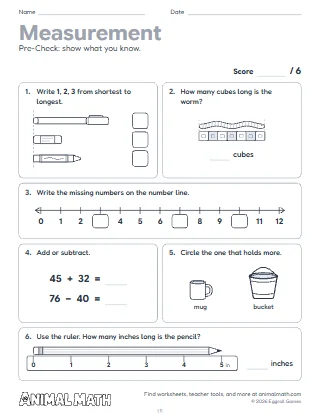
Five pages about capacity: how much a container holds, whatever its shape. Page 1 shows containers next to the cups of water that fill them: students write how many cups, then circle the two in each group that hold the same amount. A worked example comes first. On page 2 a full container is poured into an empty one marked in cups; students color the water and tell whether the two hold the same amount, and some of the empty ones hold more. Page 3 pairs a tall container with a shorter one: students read how many cups each holds and circle the one that holds more, or same. Page 4 matches containers that hold the same amount with lines, counting the cups on one side. Page 5 has four short word problems and two rows of containers to number from the least to the most they hold.
Set out a tall, thin vase and a short, wide bowl that hold about the same amount. Ask which holds more and take a vote, then fill one with cups of water, counting out loud, and pour it into the other. Do it again with rice or beans if water is not an option. Students are often surprised, which makes a good start for pages 2 and 3.
Try it in the kitchen: fill a tall glass with water and pour it into a wide bowl, or a mug into a jar. Guess first which holds more, then pour and see. Count how many cups of water fill a pot or a pitcher with a measuring cup.
This pack supports the following Common Core State Standards for Mathematics:
© Copyright 2010. National Governors Association Center for Best Practices and Council of Chief State School Officers. All rights reserved.
Capacity: containers of different shapes that hold the same amount. Students count the cups that fill a container, pour one into another, see that taller is not always more, and order containers by how much they hold.
Tell us what to make next, or build your own with a worksheet maker.
This worksheet is free to download, print, copy, and hand out in your classroom or at home. You do not need to create an account, and there are no watermarks on the PDF.