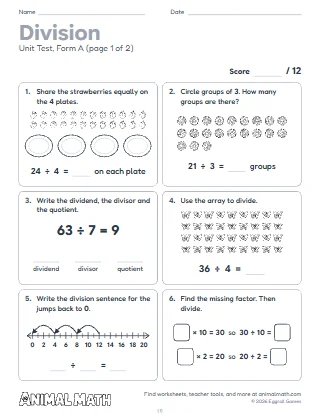
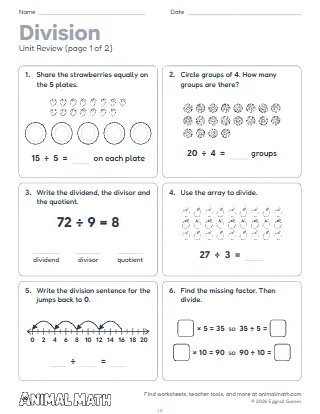
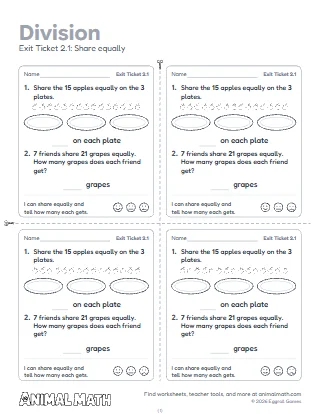
Five pages on the two meanings of division, with divisors from 2 to 10. On page 1 students share a row of pictures equally on plates or in bags: they draw the share and write how many each one gets, such as 12 shared on 3 plates is 4 on each plate. Page 2 turns it around: circle groups of a given size, such as groups of 3 in 24 rubber ducks, and write how many groups. Page 3 has sharing and grouping pictures to write a division sentence for, then a table where each row needs its dividend, divisor, quotient or whole sentence filled in. Page 4 divides with arrays (24 in rows of 6: how many rows?) and with jumps back to 0 on a number line, where the number of jumps is the quotient. Page 5 has six stories: students circle whether each asks how many in each or how many groups, then write the division sentence. Each page starts with a worked example.
Act out both meanings with the same 12 counters. First share them among 3 students: each gets 4, so 12 ÷ 3 = 4 asks how many in each. Then hand out groups of 3 until the counters run out: 4 students get a group, so 12 ÷ 3 = 4 asks how many groups. Write both on the board and ask what is the same and what is different. Before page 4, line up 20 students' steps on a floor number line and jump back by 5s to 0 together.
Divide snacks both ways. Share 15 crackers among 3 people and count how many each gets, then put 15 crackers into piles of 5 and count the piles. Ask which question each way answered: how many in each, or how many groups.
This pack supports the following Common Core State Standards for Mathematics:
© Copyright 2010. National Governors Association Center for Best Practices and Council of Chief State School Officers. All rights reserved.
Division as sharing things equally and as making equal groups, with the dividend, divisor and quotient named. Students share pictures on plates and in bags, circle equal groups, write division sentences, divide with arrays and jumps back to 0, and sort stories by what they ask.
Tell us what to make next, or build your own with a worksheet maker.
This worksheet is free to download, print, copy, and hand out in your classroom or at home. You do not need to create an account, and there are no watermarks on the PDF.