Loading preview...

Features

  • A harvest shared equally among families: how many each and what fraction one share is
  • Fair and not fair shares of a pan, and pans to cut into fair shares
  • Sharing with some left over, then cutting up the rest
  • Comparing shares of same-size pans with >, < and =
  • Word problems with whole numbers, fractions and remainders
  • Every page in color and in black and white
  • Answer keys included

Skills Covered

  • Share a group equally and name one share as a fraction
  • Tell fair shares from shares that are not fair
  • Partition a rectangle into equal parts
  • Interpret a remainder: share the leftovers as fractions
  • Compare unit fractions and fractions with the same denominator
  • Solve fraction word problems

About sharing food

Many Native nations teach that food from a harvest, a hunt or a catch is shared, so that elders and every family have enough. Families still share wild foods with elders and with households that cannot harvest for themselves. These pages use that idea for fractions: when food is shared fairly, every share is the same size, and a share has a name, like one third. The foods are corn, squash, potatoes, tomatoes, salmon and pans of cornbread.

How to Use This Pack

Five pages of 3rd grade fractions about sharing food fairly. Page 1 shares a harvest equally among families: students ring each family's row, write how many each gets and the fraction one share is. Page 2 sorts pans of cornbread into fair and not fair shares, then has students draw the cuts for 2, 3, 6 and 8 people. Page 3 hands out whole ones, then cuts up the leftovers, so each family gets a whole number and a fraction more. Page 4 compares shares of same-size pans. Page 5 has six word problems. The first problem on each page is a worked example.

In the Classroom

Before page 1, ask the class how they would share 12 ears of corn among 3 families so it is fair. Page 3 is the one to talk through: what happens to the 1 squash left over?

At Home

Share a snack fairly at home: count it out one at a time, then talk about what to do with what is left.

Tips for Success

  • Fair shares are the same size
  • One of 4 fair shares is 1/4
  • Hand out one at a time, a row each round
  • The more people share a pan, the smaller each piece
  • Same denominator: more pieces is more

Common Core Standards Alignment

This pack supports the following Common Core State Standards for Mathematics:

  • 3.OA.A.2 Understand a quotient as either the size of each equal share or the number of equal groups, such as 24 ÷ 6.
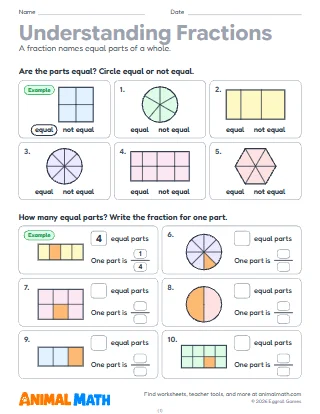
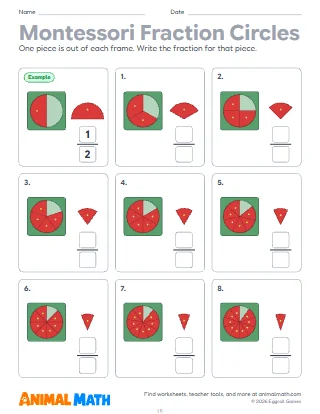
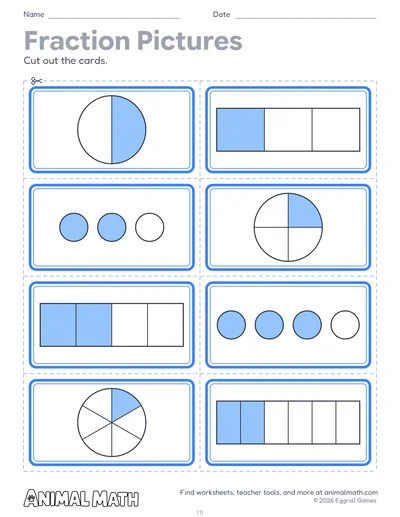
  • 3.NF.A.1 Know 1/b is one of b equal parts of a whole, and a/b is a of those parts (denominators 2, 3, 4, 6 and 8).
  • 3.NF.A.3d Compare fractions of the same whole that have equal numerators or equal denominators, thinking about part size; record with >, = or < and explain.
  • 3.G.A.2 Divide shapes into parts of equal area and describe each part with a unit fraction, such as 1/6 of the shape.
  • 4.OA.A.3 Solve multi-step story problems with whole numbers and all four operations, deciding what remainders mean, writing equations with a letter, and checking by estimating.
  • 4.NBT.B.6 Divide numbers up to 9,999 by one-digit numbers, finding quotients and remainders with place-value strategies shown in equations, arrays or area models.

© Copyright 2010. National Governors Association Center for Best Practices and Council of Chief State School Officers. All rights reserved.

Sharing Food Fractions

3rd Grade

Fractions from sharing a harvest fairly, a value many Native nations teach, with corn, squash, potatoes and pans of cornbread. Students share food equally among families, cut pans into fair shares, decide what to do with leftovers and compare shares.

Download PDF
Pin

What’s Included

  • 5 worksheets in color and in black and white, with answer keys (15 pages)
  • Equal shares of a harvest, fair shares of a pan, leftovers
  • Comparing shares and word problems
Can’t find what you need?

Tell us what to make next, or build your own with a worksheet maker.

Suggest a worksheet

Free to print and share

This worksheet is free to download, print, copy, and hand out in your classroom or at home. You do not need to create an account, and there are no watermarks on the PDF.