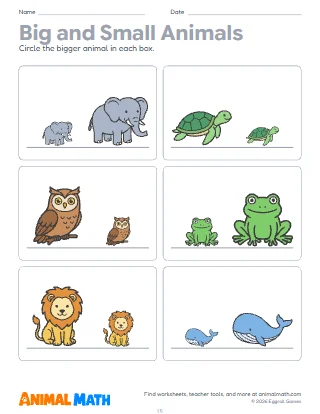
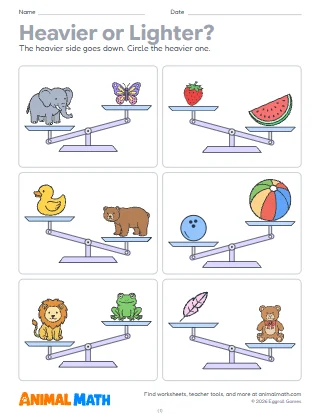
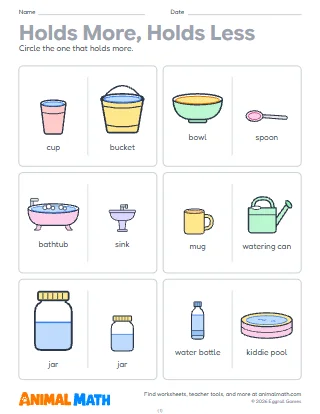
Six pages of comparing heights and lengths, always two things of the same kind. On page 1 two block towers, flowers, candles, trees, giraffes or stacks of books stand on one floor line, and students circle the taller one; page 2 asks for the shorter one. Page 3 lays crayons, worms, ribbons, pencils and markers from a start line: circle the longer one in the top half and the shorter one in the bottom half. Page 4 shows the same two things twice, once lined up and once with one starting late or standing on a box, and students circle the fair way to compare. Page 5 asks students to draw a taller tower or flower on the floor and a longer or shorter line from the start line. Page 6 names what we can measure: students circle the word that fits each picture, such as tall for a giraffe and holds water for a bucket. Each page starts with a worked example.
Compare real things first: stand two children back to back, line up two crayons on the edge of a table, build two block towers. Ask what makes it fair: both towers stand on the floor, both crayons start at the edge. Page 4 is a good talking page: ask why the late worm only looks longer. For page 6, pass around a cup, a book and a rock and ask what we could find out about each: how long, how tall, how heavy, how much it holds.
Line up shoes, spoons or toy cars against a wall and ask which is longer. Stand stuffed animals on the floor and ask which is taller and which is shorter. Ask your child to find something heavy, something long and something that holds water.
This pack supports the following Common Core State Standards for Mathematics:
© Copyright 2010. National Governors Association Center for Best Practices and Council of Chief State School Officers. All rights reserved.
Comparing how tall and how long things are, side by side, and naming what we can measure about a thing. Students circle the taller, shorter or longer of two, find the fair way to line things up, draw one taller, longer or shorter, and pick the word that fits a picture: tall, long, heavy or holds water.
Tell us what to make next, or build your own with a worksheet maker.
This worksheet is free to download, print, copy, and hand out in your classroom or at home. You do not need to create an account, and there are no watermarks on the PDF.