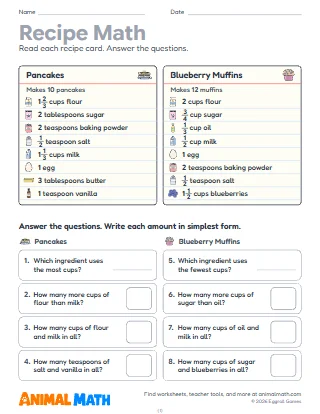
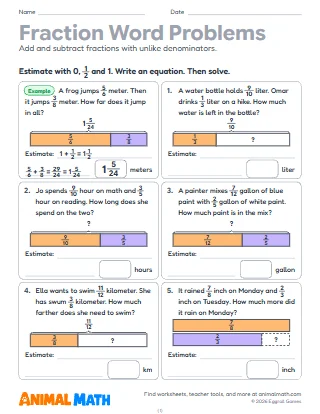
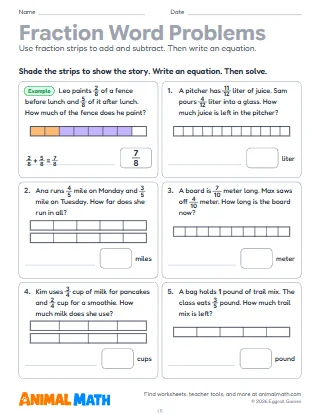
Read and color glass measuring cups marked in fourths, thirds and eighths
Add and subtract amounts on pumpkin pie and cornbread recipe cards
Triple a cranberry sauce recipe and solve feast stories
Unlike denominators, half of an apple crisp recipe, and scoops and shares to divide
Pages 1 to 3 are 4th grade work, pages 4 to 6 are 5th grade work
Every page in color and in black and white
Answer keys included
Skills Covered
Read amounts on a measuring cup in fourths, thirds and eighths
Add and subtract fractions and mixed numbers with like denominators
Multiply a fraction or a mixed number by a whole number
Add and subtract fractions and mixed numbers with unlike denominators
Multiply a fraction by a fraction on an area model
Divide a whole number by a unit fraction, and a unit fraction by a whole number
How to Use This Pack
Six pages of fractions in the Thanksgiving kitchen. Pages 1 to 3 are 4th grade work. Page 1 reads four measuring cups (marked in fourths and thirds), adds and subtracts what they hold, then colors cups to show amounts like 1 3/4 cups and 5/8 cup. Page 2 has a pumpkin pie card and a cornbread card with eight questions: how much in all and how much more, with like denominators and mixed numbers that need regrouping (1 1/4 − 3/4). Page 3 triples a cranberry sauce recipe in a table and solves four feast stories that multiply a fraction or a mixed number by a whole number. Pages 4 to 6 are 5th grade work. Page 4 has six kitchen stories with unlike denominators (3/4 cup + 2/3 cup). Page 5 shades 1/2, 1/3 or 1/4 of an amount on area models, then halves an apple crisp recipe. Page 6 counts how many 1/4, 1/3 or 1/2 cup scoops make a few cups, and shares a unit fraction equally (1/2 cup of gravy in 4 bowls). Answer keys give every answer in simplest form, with the other right forms beside it (1 1/2, or 6/4).
In the Classroom
Bring a glass measuring cup and a set of dry measuring cups. Before page 1, pour water to a few marks and read them together, counting the small marks between the numbers. Before page 6, scoop 2 cups of rice with a 1/4 cup and count the scoops. Use pages 1 to 3 with 4th graders and pages 4 to 6 with 5th graders, or give a 5th grade class page 2 or 3 as a warm-up. Page 4 works well in pairs: one student finds the common denominator, the other checks the answer.
At Home
Cook a Thanksgiving dish together and let your child measure. Ask: if we make three times as much, how much sugar do we need? How many 1/4 cup scoops make 2 cups? Doubling or halving a family recipe on paper before you shop is real fraction practice.
Tips for Success
Count the small marks between two numbers on the cup to find what each mark is worth
To triple a recipe, multiply each amount by 3: 3 × 3/4 = 9/4 = 2 1/4
Fewer parts to take away from? Trade 1 whole for 4/4: 1 1/4 − 3/4 = 5/4 − 3/4 = 2/4
Find a common denominator before you add or subtract: 3/4 + 2/3 = 9/12 + 8/12
Half of an amount is 1/2 times the amount
How many 1/4 cups in 2 cups? Each cup holds 4 of them: 2 ÷ 1/4 = 8
This pack supports the following Common Core State Standards for Mathematics:
4.NF.B.3a Understand adding and subtracting fractions as joining and taking away parts of the same whole.
4.NF.B.3c Add and subtract mixed numbers with the same denominator, for example by changing them to fractions or by using properties of operations.
4.NF.B.3d Solve story problems that add or subtract fractions of the same whole with like denominators, using fraction models and equations.
4.NF.B.4a See a fraction a/b as a copies of 1/b, such as 7/3 = 7 × (1/3), and show it with a fraction model.
4.NF.B.4b Find a whole number times a fraction by counting unit fractions: 4 × (2/3) is 8 copies of 1/3, which is 8/3.
4.NF.B.4c Solve story problems with a whole number times a fraction, using models and equations, and name the two whole numbers the answer falls between.
4.MD.A.2 Solve story problems on distance, time, liquid volume, mass and money with any operation, simple fractions or decimals and unit changes, using number-line diagrams.
4.MD.B.4 Make a line plot of measurements in halves, quarters and eighths, and use it to solve problems that add and subtract fractions.
5.NF.A.1 Add and subtract fractions and mixed numbers with unlike denominators by rewriting them as equivalent fractions with a common denominator.
5.NF.A.2 Solve story problems that add or subtract fractions of one whole, unlike denominators included, and check that answers make sense with benchmark fractions and estimating.
5.NF.B.4a Multiply a whole number or fraction by a fraction, seeing (3/4) × 2 as 3 of the 4 equal parts of 2, using models.
5.NF.B.4b Tile a rectangle with fraction side lengths using squares whose sides are unit fractions, and see the area equals the two sides multiplied.
5.NF.B.5a Without multiplying, tell how the size of a product compares to one factor by looking at the size of the other factor.
5.NF.B.5b Explain why multiplying by a fraction above 1 makes a number bigger and below 1 makes it smaller; see equivalent fractions as multiplying by 1.
5.NF.B.6 Solve real-life problems that multiply fractions and mixed numbers, using fraction models or equations.
5.NF.B.7a Divide a unit fraction by a whole number, such as (1/2) ÷ 3 = 1/6, using models and stories, and check by multiplying.
5.NF.B.7b Find how many unit fractions fit in a whole number, such as 3 ÷ (1/4) = 12, using models and stories, and check by multiplying.
5.NF.B.7c Solve real-life problems that divide unit fractions by whole numbers or whole numbers by unit fractions, like how many 1/4-cup scoops fill 3 cups.
5.MD.A.1 Change measurements between bigger and smaller units of one system, such as 250 cm to 2.5 m, and use this in multi-step real-life problems.
5.MD.B.2 Make a line plot of measurements in halves, quarters and eighths, and solve problems from it with fraction operations, like sharing a total equally.
Fractions in the Thanksgiving kitchen, with measuring cups, recipe cards for pumpkin pie, cornbread, cranberry sauce and apple crisp, and feast stories. Students read and fill measuring cups, add and subtract amounts, triple and halve recipes, and divide cups into scoops and equal shares.
This worksheet is free to download, print, copy, and hand out in your classroom or at home. You do not need to create an account, and there are no watermarks on the PDF.