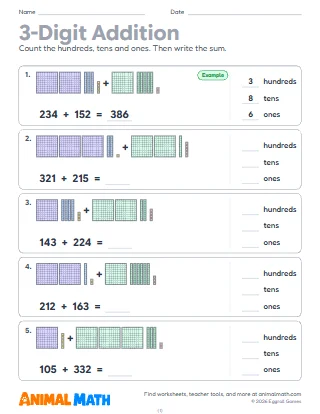
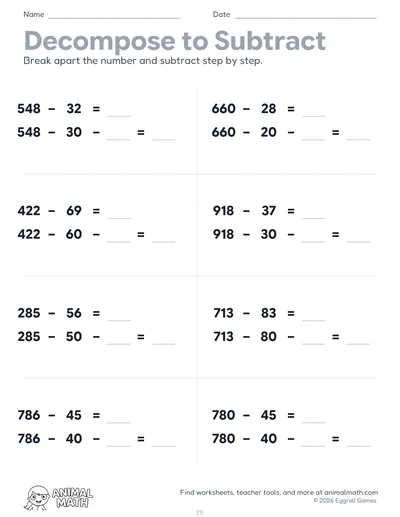
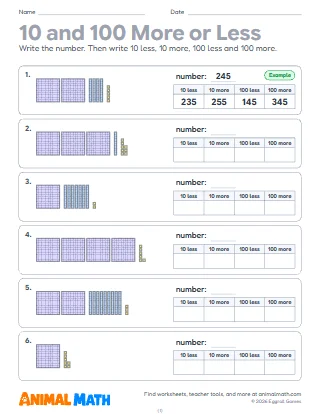
Five pages that take three-digit subtraction from blocks to the written method. Page 1 shows the first number in base-ten blocks: students trade one ten for 10 ones or one hundred for 10 tens (425 is 3 hundreds 12 tens 5 ones), write the trade in a small table and cross out what they take away; the answer key crosses out whole flats and rods, the loose ones, and the cubes of a traded rod or the columns of a traded flat. Page 2 uses a place value table: the number, the number after trading, the number taken away, and what is left. Page 3 is twelve column problems that trade a ten, a hundred or both. Page 4 is twelve problems across a zero (405 - 178, 300 - 126), where a hundred becomes 10 tens before a ten can become 10 ones. Page 5 subtracts and checks by adding, then shows two animals with different answers: one takes the smaller digit from the bigger (452 - 178 = 326), one trades across the zero but keeps the hundred (604 - 278 = 426). The keys write each traded place's new digits over the crossed-out ones. Each page starts with a worked example.
Before page 4, build 405 with 4 flats and 5 cubes and ask a student to take away 8 ones. There are no rods to trade, so the class has to decide what to do with a flat first. Write each trade on the board as you make it (3 hundreds 10 tens 5 ones, then 3 hundreds 9 tens 15 ones). Page 5's check by adding is the habit to keep for every subtraction.
Practice with money: you have $4.05 and spend $1.78. Trade a dollar for 10 dimes, then a dime for 10 pennies, and count what is left. Ask your child to check by adding the answer to $1.78.
This pack supports the following Common Core State Standards for Mathematics:
© Copyright 2010. National Governors Association Center for Best Practices and Council of Chief State School Officers. All rights reserved.
A 5-page 2nd grade pack for subtracting three-digit numbers within 1,000. Trade a ten or a hundred in base-ten blocks and cross out what you take away, then use a place value table to trade and subtract. Subtract in columns, trading a ten, a hundred or both, and across a zero (405 - 178, 300 - 126). Last, check by adding and decide which animal is right: one takes the smaller digit from the bigger, one trades across a zero but keeps the hundred. Every page comes in color and in black and white. Answer keys included.
Tell us what to make next, or build your own with a worksheet maker.
This worksheet is free to download, print, copy, and hand out in your classroom or at home. You do not need to create an account, and there are no watermarks on the PDF.