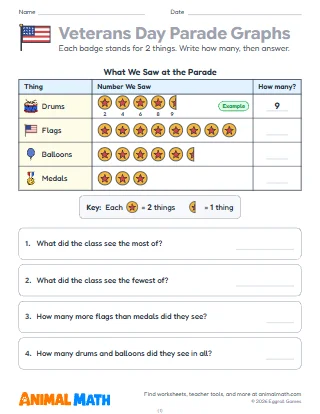
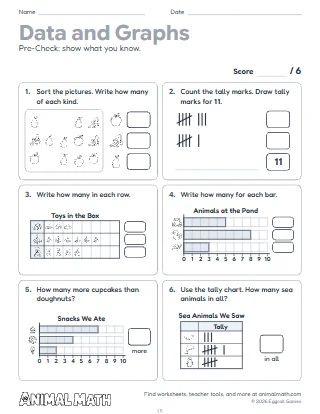
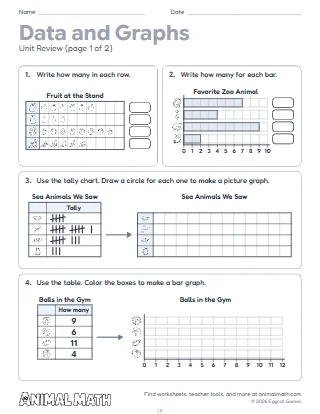
Five pages of Christmas lists for the elves to count, one step up on each page. Page 1, for 1st grade, has eight lists with teddy bears, cars and balls: make a tally mark for each toy, write how many of each in a sentence ("The elves make 7 teddy bears"), then circle the toy they make the most of and the fewest of, and find how many more and how many in all. Ava’s list is ticked off and tallied as the example. Page 2, for 2nd grade, has ten lists with four toys: tally them, write the totals and draw a bar for each toy on the graph (the robots are done as the example), then answer put together, take apart and compare questions. Page 3 has lists with numbers, such as 3 tops and 2 cars: add up each toy on the workshop’s order form, one box for each list, then add the four totals for the toys in all. Page 4, for 3rd grade, gives a whole town’s orders in a table: draw one circle for every 5 toys to make a scaled picture graph, then answer one- and two-step questions. Page 5 has six workshop stories about workbenches, shelves, sacks and boxes: circle × or ÷, write an equation and the answer. Each page starts with a worked example.
Have each student write a short Christmas list of three toys from a set the class picks, then collect the lists and tally them together on the board before page 1 or 2. Ask which toy the elves should make the most of and how they know. For page 4, ask how the graph would change if each circle stood for 10 toys, and how to show 45 then.
Write your own family’s Christmas lists with numbers, such as 2 books and 1 puzzle, and add them up the way the elves do on page 3. Make a quick tally chart of the toys in a toy box, then draw a bar graph of it.
This pack supports the following Common Core State Standards for Mathematics:
© Copyright 2010. National Governors Association Center for Best Practices and Council of Chief State School Officers. All rights reserved.
Children’s Christmas lists arrive at the elves’ workshop, and the elves need to know how many of each toy to make. Students tally the toys on the lists, make a bar graph and a scaled picture graph, add up an order form and solve multiplication and division stories about making and packing the toys.
Tell us what to make next, or build your own with a worksheet maker.
This worksheet is free to download, print, copy, and hand out in your classroom or at home. You do not need to create an account, and there are no watermarks on the PDF.