Loading preview...

Features

  • Forms A and B ask the same questions with different numbers
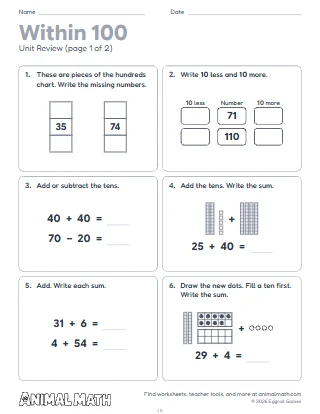
  • Find 10 more and 10 less on the hundreds chart and in their heads, add and subtract tens, and add tens to any number
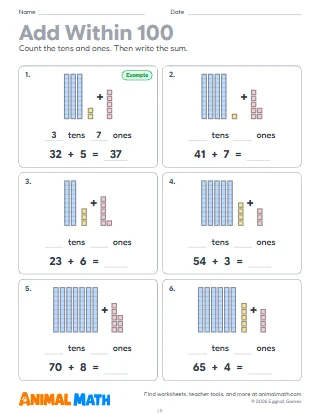
  • Add a one-digit number with and without making a new ten, and add with base-ten drawings and on a number line
  • Take away tens by breaking a number apart, and solve a story problem
  • Fill in hundreds chart pieces and explain how they added
  • Subtraction only ever takes away tens, as in 1st grade
  • Answer keys name the lesson and skill of every question

Skills Covered

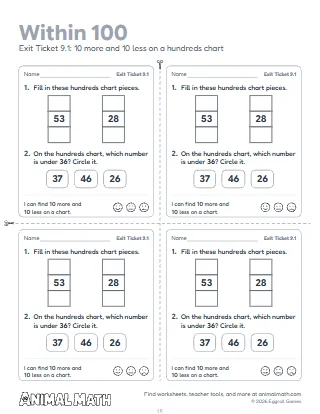
  • Find 10 more and 10 less on a hundreds chart and in your head
  • Add and subtract tens (30 + 40, 70 − 40)
  • Add tens to any number (34 + 20)
  • Add a one-digit number with no new ten
  • Add a one-digit number and make a new ten
  • Add with base-ten drawings
  • Add on a number line by hopping to the next ten
  • Take away tens by breaking a number apart
  • Solve story problems within 100
  • Fill in hundreds chart pieces; explain how you added

How to Use This Pack

The unit test on adding and subtracting within 100. Pages 1 and 2 are Form A. Pages 3 and 4 are Form B: the same questions in the same order with different numbers, for a retake, a make-up or a second seating. Each form has 12 questions, one point each, and a Score line on its first page. The pre-check and the unit review are packs of their own.

In the Classroom

Give Form A the day after the unit review. On questions 7, 8, 9 and 12 students show a strategy; the answer key draws one way to do it, and any way that works is right. The answer keys name each question's skill, so a missed question points to the lesson to reteach.

At Home

Use Form B as a check after the unit. Ask your child to add 10 to a number in their head, then to explain how they knew.

Tips for Success

  • Read the questions aloud for students who are still learning to read
  • Go over the unit review the day before the test
  • Adding or taking away tens changes only the tens digit
  • To add 38 + 5, make the next ten first: 38 + 2 = 40, then 40 + 3
  • Use Form B as a retake after reteaching what was missed

Common Core Standards Alignment

This pack supports the following Common Core State Standards for Mathematics:

  • 1.NBT.A.1 Count up to 120 from any starting number, and read, write and use numerals up to 120 to show how many objects.
  • 1.NBT.C.4 Find sums up to 100 (two-digit plus one-digit, or plus a multiple of 10) with models and place value, making a new ten when needed.
  • 1.NBT.C.5 Without counting, find the number 10 greater or 10 smaller than any two-digit number, doing it mentally and explaining why.
  • 1.NBT.C.6 Subtract one multiple of 10 from another (between 10 and 90, answer zero or more), such as 70 - 40, using models or place value.
  • 2.MD.B.6 Show whole numbers as distances from 0 on an evenly marked number line, and show sums and differences up to 100 as jumps on it.

© Copyright 2010. National Governors Association Center for Best Practices and Council of Chief State School Officers. All rights reserved.

1st Grade Add and Subtract Within 100 Test

The unit test on adding and subtracting within 100, in two forms, A and B. Questions cover 10 more and 10 less, adding tens, making a new ten, taking away tens and story problems.

Download PDF
Pin

What’s Included

  • The unit test in two forms, A and B (12 questions each)
  • Answer keys that name each question's lesson and skill (8 pages in all)
Can’t find what you need?

Tell us what to make next, or build your own with a worksheet maker.

Suggest a worksheet

Free to print and share

This worksheet is free to download, print, copy, and hand out in your classroom or at home. You do not need to create an account, and there are no watermarks on the PDF.