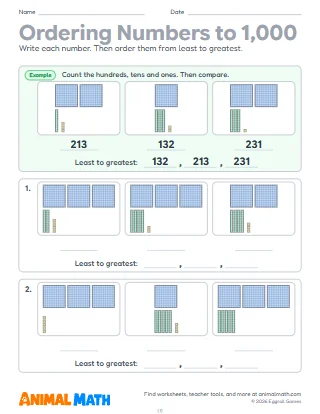
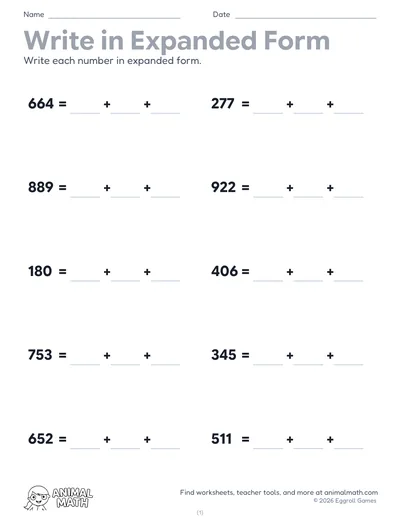
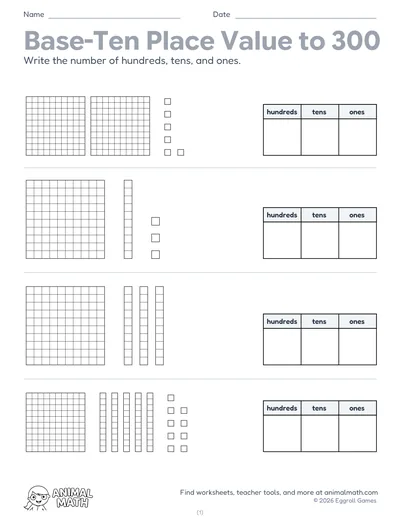
Five pages on where three-digit numbers sit and which is greater. Page 1 has five number lines (0 to 1,000 by hundreds, 300 to 400 by tens, 640 to 650 by ones): write the number at each arrow. Page 2 is the reverse: find each number on the line, draw a dot and label it. Page 3 shows two base-ten pictures: write both numbers and >, < or = between them; one pair uses different blocks for the same number (3 hundreds 12 tens 4 ones and 4 hundreds 2 tens 4 ones). Page 4 puts two numbers in a place value table: write the digits, circle the first place where they differ, then compare (398 < 401, though 8 ones beat 1 one). Page 5 compares numbers written in different ways, such as 400 + 6 and 460 or "six hundred ninety-nine" and "seven hundred", then orders four numbers from least to greatest. Each page starts with a worked example.
Before page 4, put 583 and 538 in a table on the board and ask which place to look at first. Students who look at the ones first will say 538: let them build both numbers with blocks to see why the hundreds, then the tens, decide.
Compare prices of two things that cost a few hundred dollars, or the page counts of two books. Ask which is greater and which place told you.
This pack supports the following Common Core State Standards for Mathematics:
© Copyright 2010. National Governors Association Center for Best Practices and Council of Chief State School Officers. All rights reserved.
A 5-page 2nd grade pack for placing and comparing numbers to 1,000. Read number lines from 0 to 1,000 by hundreds, across a hundred by tens and across ten numbers by ones, then mark numbers on them. Compare base-ten pictures with >, < and = (3 hundreds 12 tens is the same as 424), use a place value table to find the place that decides, and compare numbers written as expanded forms, hundreds, tens and ones, and words. The last problems put four numbers in order. Every page comes in color and in black and white. Answer keys included.
Tell us what to make next, or build your own with a worksheet maker.
This worksheet is free to download, print, copy, and hand out in your classroom or at home. You do not need to create an account, and there are no watermarks on the PDF.