Loading preview...

Features

  • The goal and its "I can" line, what to get ready and the words to use
  • A 45 minute lesson in five steps (warm up, teach with words to say, try it together, practice, exit ticket)
  • Questions to ask, and the mistakes students make and what to do about them
  • Ideas for students who need help or are ready for more
  • Each plan ends with the Animal Math worksheets, worksheet makers, tool and quizzes for that lesson
  • Lessons: line plots in eighths and the problems they solve, planning how to collect data, the mean, the median, mode and range, stem-and-leaf plots and frequency tables, line graphs and double bar graphs, scatterplots, histograms and circle graphs, probability from 0 to 1, and sample spaces
  • Lessons 15.3 to 15.11 are for the states that teach them in 5th grade

5th Grade Math CurriculumUnit 15

These are the lesson plans for Unit 15 of 16 in the 5th Grade Math Curriculum: 127 lessons in teaching order, week by week, each with a lesson plan and an exit ticket.

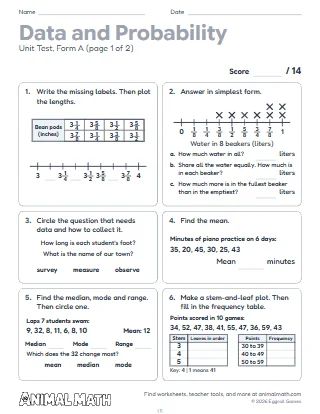
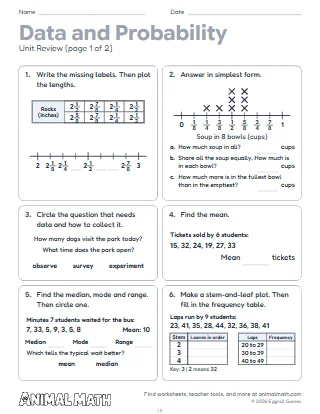
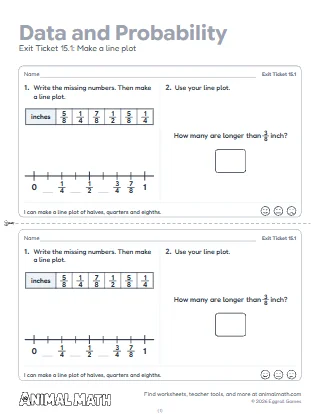
Also for this unit: exit tickets, pre-check, unit review and test. See the whole year

Resources for Each Lesson

Everything each lesson plan points to, with links. Sheet numbers count worksheets: a color pack prints each sheet again in black and white.

15.1 Make a line plot

15.2 Solve problems with a line plot

15.3 Plan how to collect data ★

15.4 The mean ★

15.5 Median, mode and range ★

15.6 Stem-and-leaf plots and frequency tables ★

15.7 Line graphs and double bar graphs ★

15.8 Scatterplots ★

15.9 Histograms and circle graphs ★

15.10 Probability from 0 to 1 ★

15.11 Sample spaces ★

★ Taught in 5th grade in some states.

Skills Covered

  • Make a line plot in halves, quarters and eighths
  • Add, subtract and share a total with a line plot
  • Plan how to collect data
  • Find the mean as a fair share
  • Find the median, mode and range
  • Make stem-and-leaf plots and frequency tables
  • Read line graphs and double bar graphs
  • Make a scatterplot and tell its trend
  • Read histograms and circle graphs
  • Write a probability from 0 to 1
  • List sample spaces and count outcomes by multiplying

How to Use This Pack

Eleven lesson plans, one for each lesson of a 5th grade unit on data and probability, in teaching order, after an overview page that lays the unit out day by day: a pre-check, the eleven lessons, a review and the unit test. Each plan fits on one page. It gives the goal, what to get ready, the words to use, the lesson in five steps with the words to say, questions to ask, common mistakes and what to do about them, and the Animal Math worksheets, makers, tool and quizzes for the lesson.

In the Classroom

Print the unit, or just the day's page, and teach from it. Each lesson takes about 45 minutes: a 5 minute warm up, 10 minutes of teaching, 10 minutes together, 15 minutes of practice and an exit ticket at the end. Lessons 15.3 to 15.11 are taught in 5th grade in some states only: planning how to collect data (Florida, Georgia, Indiana and Virginia), the mean (Florida, Indiana, Oklahoma and Virginia), the median, mode and range (those four and South Carolina), stem-and-leaf plots and frequency tables (Texas and Virginia), line graphs and double bar graphs (Florida, Georgia, Oklahoma, South Carolina and Texas), scatterplots (Texas), histograms and circle graphs (Indiana and South Carolina), probability from 0 to 1 (South Carolina and Virginia) and sample spaces (Virginia); skip the ones your class does not learn. The exit tickets, pre-check, review and unit test are separate packs, made for these lessons, and the plans use other data than they do.

At Home

Teaching at home? Use the warm up and the "Try it together" step as a short lesson, and the "Words to use" as the way to talk about it. A ruler marked in eighths, a bag of colored blocks, a coin, a number cube and the family's own numbers (minutes of reading, heights, the week's temperatures) work as well as classroom ones. The mistakes to watch for are the ones most children make.

Tips for Success

  • Read the "Watch for" box before the lesson: it is what to listen for while students work
  • Write halves and quarters as eighths before plotting, adding or sharing them
  • Put the data in order before finding the median, and read the scale before reading any graph
  • Sort the exit tickets into got it, almost and not yet to plan the next day
  • Use the help and challenge ideas for small groups during practice

Common Core Standards Alignment

This pack supports the following Common Core State Standards for Mathematics:

  • 5.NF.A.1 Add and subtract fractions and mixed numbers with unlike denominators by rewriting them as equivalent fractions with a common denominator.
  • 5.NF.A.2 Solve story problems that add or subtract fractions of one whole, unlike denominators included, and check that answers make sense with benchmark fractions and estimating.
  • 5.MD.B.2 Make a line plot of measurements in halves, quarters and eighths, and solve problems from it with fraction operations, like sharing a total equally.

© Copyright 2010. National Governors Association Center for Best Practices and Council of Chief State School Officers. All rights reserved.

5th Grade Data and Probability Lesson Plans

Lesson plans for every lesson of a unit on line plots, data and probability, from line plots in eighths and the mean, median and mode to scatterplots, circle graphs and sample spaces. Each plan gives a lesson in five steps, words to say, common mistakes and the worksheets to use, after a unit overview.

Download PDF
Pin

What’s Included

  • 11 one-page lesson plans, one for each lesson of the unit
  • A unit overview: the unit day by day, what to get ready, how each lesson goes
  • Words to say, questions to ask and common mistakes for every lesson
  • The worksheets, makers, tool and quizzes for each lesson (12 pages in all)
Can’t find what you need?

Tell us what to make next, or build your own with a worksheet maker.

Suggest a worksheet

Free to print and share

This worksheet is free to download, print, copy, and hand out in your classroom or at home. You do not need to create an account, and there are no watermarks on the PDF.