5th Grade Math Curriculum

A full year of 5th grade math in 16 units and 127 lessons, free to print. Every lesson has a one-page lesson plan (how to teach it, the words to use, the mistakes to watch for) and an exit ticket, and every unit has a pre-check, a review and a test in two forms. Each lesson plan points to the worksheets, worksheet makers, teaching tools and quizzes that practice it. The plan below counts one lesson a day, with a day for the pre-check, the review and the test of each unit: 175 days, which leaves room in a 180-day year for catching up, holidays and seasonal packs.
16 units127 lessons175 days35 weeks

Unit 1

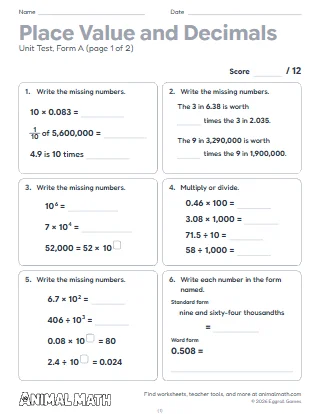
Place Value and Decimals

Weeks 1–2 · 10 days

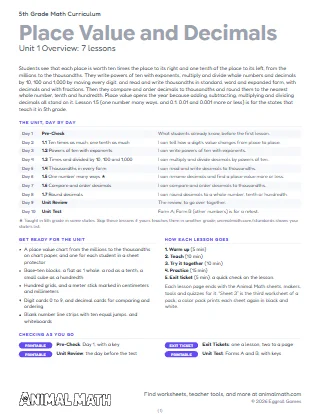
Students see that each place is worth ten times the place to its right and one tenth of the place to its left, from the millions to the thousandths. They write powers of ten with exponents, multiply and divide whole numbers and decimals by 10, 100 and 1,000 by moving every digit, and read and write thousandths in standard, word and expanded form, with decimals and with fractions. Then they compare and order decimals to thousandths and round them to the nearest whole number, tenth and hundredth. Place value opens the year because adding, subtracting, multiplying and dividing decimals all stand on it. Lesson 1.5 (one number many ways, and 0.1, 0.01 and 0.001 more or less) is for the states that teach it in 5th grade.
Week 1
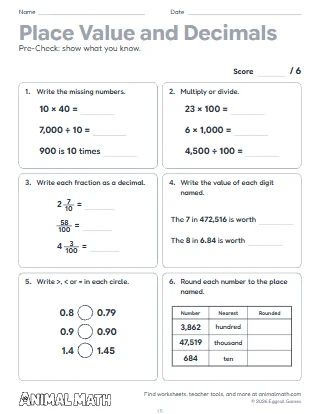
Day 1Pre-CheckWhat students already know, before the unit.
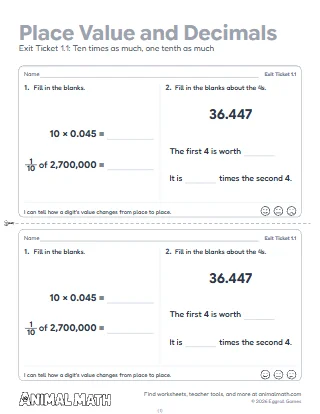
Day 21.1 Ten times as much, one tenth as muchI can tell how a digit’s value changes from place to place.
Day 31.2 Powers of ten with exponentsI can write powers of ten with exponents.
Day 41.3 Times and divided by 10, 100 and 1,000I can multiply and divide decimals by powers of ten.
Day 51.4 Thousandths in every formI can read and write decimals to thousandths.
Week 2
Day 61.5 One number many ways ★I can rename decimals and find a place value more or less.
Day 71.6 Compare and order decimalsI can compare and order decimals to thousandths.
Day 81.7 Round decimalsI can round decimals to a whole number, tenth or hundredth.
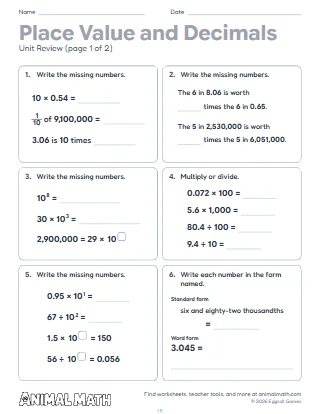
Day 9Unit ReviewThe review, to go over together.
Day 10Unit TestForm A; Form B (other numbers) is for a retest.
Unit 2

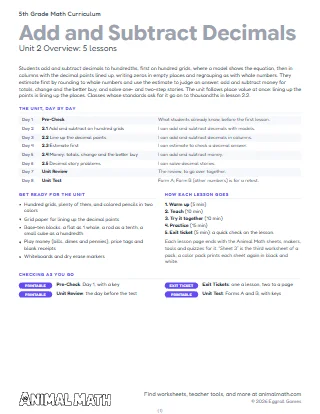
Adding and Subtracting Decimals

Weeks 3–4 · 8 days

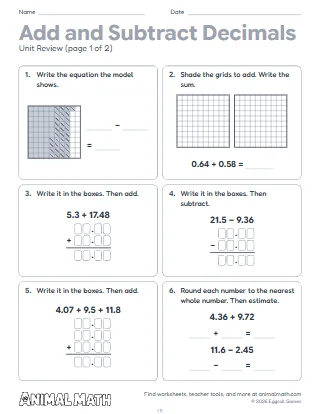
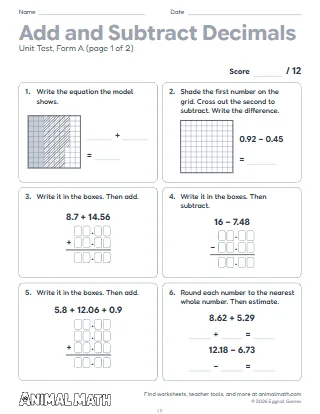
Students add and subtract decimals to hundredths, first on hundred grids, where a model shows the equation, then in columns with the decimal points lined up, writing zeros in empty places and regrouping as with whole numbers. They estimate first by rounding to whole numbers and use the estimate to judge an answer, add and subtract money for totals, change and the better buy, and solve one- and two-step stories. The unit follows place value at once: lining up the points is lining up the places. Classes whose standards ask for it go on to thousandths in lesson 2.2.

Week 3
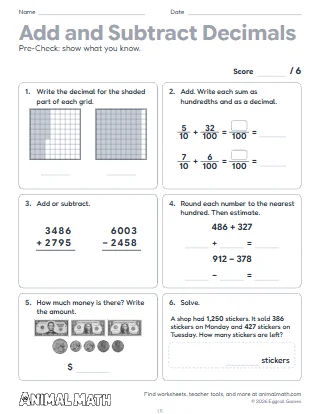
Day 11Pre-CheckWhat students already know, before the unit.
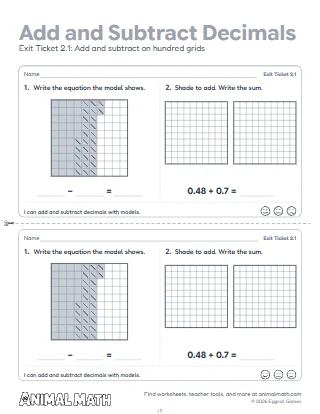
Day 122.1 Add and subtract on hundred gridsI can add and subtract decimals with models.
Day 132.2 Line up the decimal pointsI can add and subtract decimals in columns.
Day 142.3 Estimate firstI can estimate to check a decimal answer.
Day 152.4 Money: totals, change and the better buyI can add and subtract money.
Week 4
Day 162.5 Decimal story problemsI can solve decimal stories.
Day 17Unit ReviewThe review, to go over together.
Day 18Unit TestForm A; Form B (other numbers) is for a retest.
Unit 3

Multiplying Whole Numbers

Weeks 4–6 · 10 days

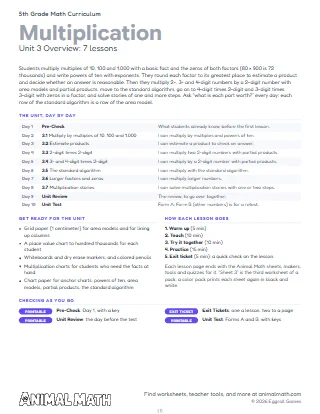
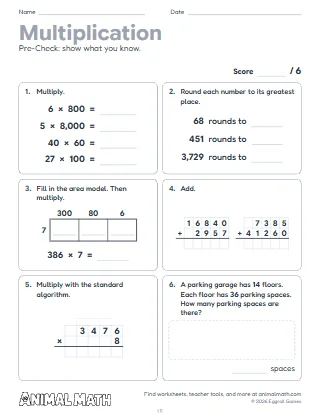
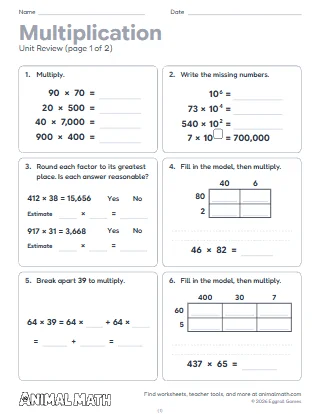
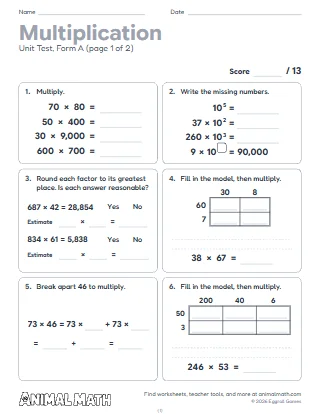
Students multiply multiples of 10, 100 and 1,000 with a basic fact and the zeros of both factors (80 × 900 is 72 thousands) and write powers of ten with exponents. They round each factor to its greatest place to estimate a product and decide whether an answer is reasonable. Then they multiply 2-, 3- and 4-digit numbers by a 2-digit number with area models and partial products, move to the standard algorithm, go on to 4-digit times 2-digit and 3-digit times 3-digit with zeros in a factor, and solve stories of one and more steps. Ask “what is each part worth?” every day: each row of the standard algorithm is a row of the area model.

Week 4 (continued)
Day 19Pre-CheckWhat students already know, before the unit.
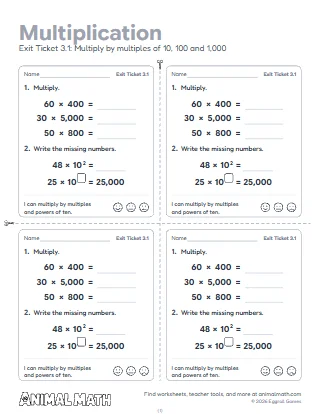
Day 203.1 Multiply by multiples of 10, 100 and 1,000I can multiply by multiples and powers of ten.
Week 5
Day 213.2 Estimate productsI can estimate a product to check an answer.
Day 223.3 2-digit times 2-digitI can multiply two 2-digit numbers with partial products.
Day 233.4 3- and 4-digit times 2-digitI can multiply by a 2-digit number with partial products.
Day 243.5 The standard algorithmI can multiply with the standard algorithm.
Day 253.6 Larger factors and zerosI can multiply larger numbers.
Week 6
Day 263.7 Multiplication storiesI can solve multiplication stories with one or two steps.
Day 27Unit ReviewThe review, to go over together.
Day 28Unit TestForm A; Form B (other numbers) is for a retest.
Unit 4

Dividing Whole Numbers

Weeks 6–8 · 11 days

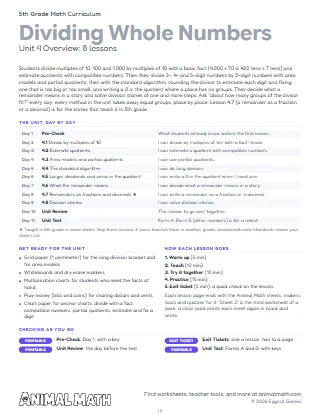
Students divide multiples of 10, 100 and 1,000 by multiples of 10 with a basic fact (4,200 ÷ 70 is 420 tens ÷ 7 tens) and estimate quotients with compatible numbers. Then they divide 3-, 4- and 5-digit numbers by 2-digit numbers with area models and partial quotients, then with the standard algorithm, rounding the divisor to estimate each digit and fixing one that is too big or too small, and writing a 0 in the quotient where a place has no groups. They decide what a remainder means in a story and solve division stories of one and more steps. Ask “about how many groups of the divisor fit?” every day: every method in the unit takes away equal groups, place by place. Lesson 4.7 (a remainder as a fraction or a decimal) is for the states that teach it in 5th grade.

Week 6 (continued)
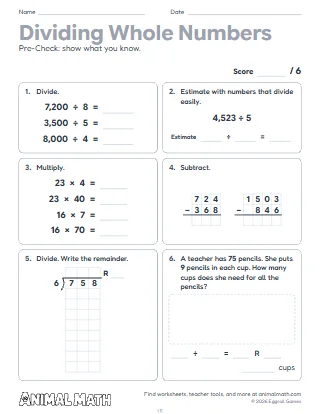
Day 29Pre-CheckWhat students already know, before the unit.
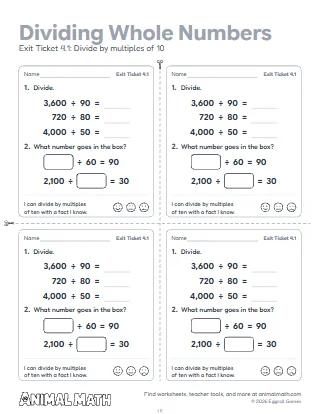
Day 304.1 Divide by multiples of 10I can divide by multiples of ten with a fact I know.
Week 7
Day 314.2 Estimate quotientsI can estimate a quotient with compatible numbers.
Day 324.3 Area models and partial quotientsI can use partial quotients.
Day 334.4 The standard algorithmI can do long division.
Day 344.5 Larger dividends and zeros in the quotientI can write a 0 in the quotient when I need one.
Day 354.6 What the remainder meansI can decide what a remainder means in a story.
Week 8
Day 364.7 Remainders as fractions and decimals ★I can write a remainder as a fraction or a decimal.
Day 374.8 Division storiesI can solve division stories.
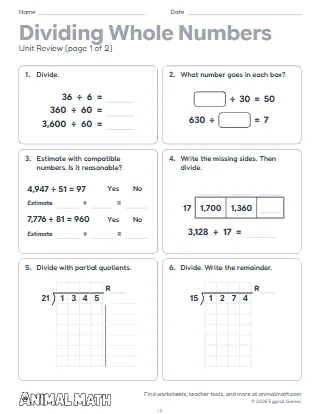
Day 38Unit ReviewThe review, to go over together.
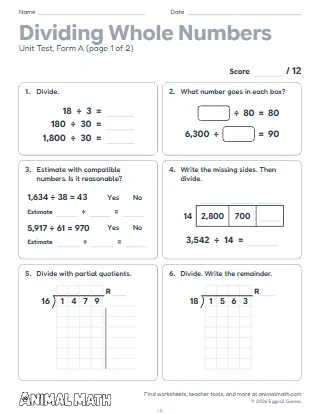
Day 39Unit TestForm A; Form B (other numbers) is for a retest.
Unit 5

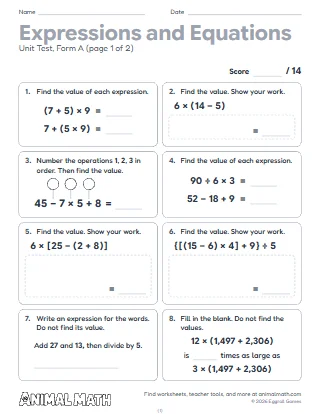
Expressions and Equations

Weeks 8–10 · 11 days

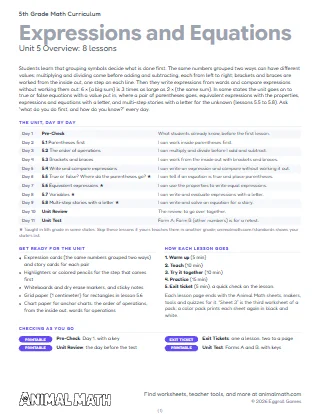
Students learn that grouping symbols decide what is done first. The same numbers grouped two ways can have different values; multiplying and dividing come before adding and subtracting, each from left to right; brackets and braces are worked from the inside out, one step on each line. Then they write expressions from words and compare expressions without working them out: 6 × (a big sum) is 3 times as large as 2 × (the same sum). In some states the unit goes on to true or false equations with a value put in, where a pair of parentheses goes, equivalent expressions with the properties, expressions and equations with a letter, and multi-step stories with a letter for the unknown (lessons 5.5 to 5.8). Ask “what do you do first, and how do you know?” every day.

Week 8 (continued)
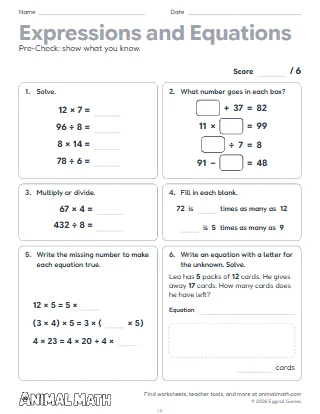
Day 40Pre-CheckWhat students already know, before the unit.
Week 9
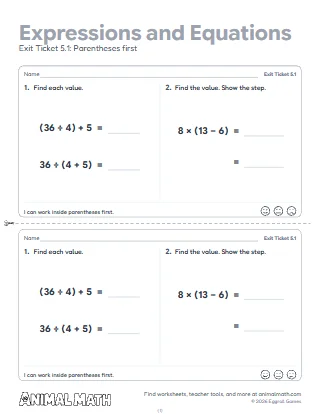
Day 415.1 Parentheses firstI can work inside parentheses first.
Day 425.2 The order of operationsI can multiply and divide before I add and subtract.
Day 435.3 Brackets and bracesI can work from the inside out with brackets and braces.
Day 445.4 Write and compare expressionsI can write an expression and compare without working it out.
Day 455.5 True or false? Where do the parentheses go? ★I can tell if an equation is true and place parentheses.
Week 10
Day 465.6 Equivalent expressions ★I can use the properties to write equal expressions.
Day 475.7 Variables ★I can write and evaluate expressions with a letter.
Day 485.8 Multi-step stories with a letter ★I can write and solve an equation for a story.
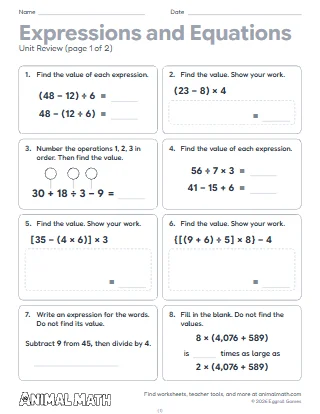
Day 49Unit ReviewThe review, to go over together.
Day 50Unit TestForm A; Form B (other numbers) is for a retest.
Unit 6

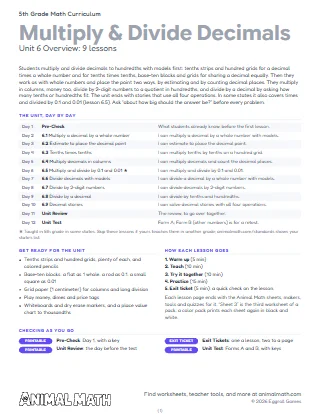
Multiplying and Dividing Decimals

Weeks 11–13 · 12 days

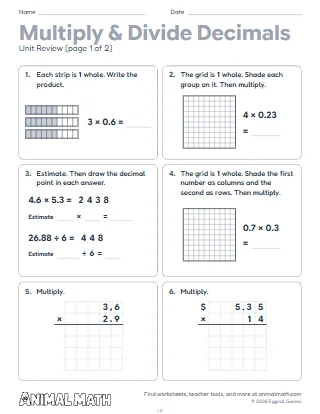
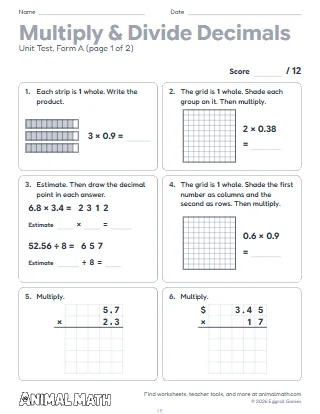
Students multiply and divide decimals to hundredths with models first: tenths strips and hundred grids for a decimal times a whole number and for tenths times tenths, base-ten blocks and grids for sharing a decimal equally. Then they work as with whole numbers and place the point two ways, by estimating and by counting decimal places. They multiply in columns, money too, divide by 2-digit numbers to a quotient in hundredths, and divide by a decimal by asking how many tenths or hundredths fit. The unit ends with stories that use all four operations. In some states it also covers times and divided by 0.1 and 0.01 (lesson 6.5). Ask “about how big should the answer be?” before every problem.

Week 11
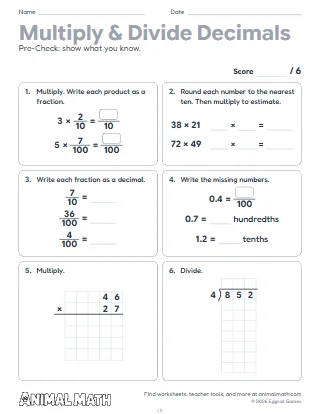
Day 51Pre-CheckWhat students already know, before the unit.
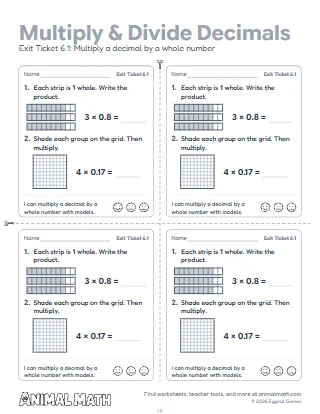
Day 526.1 Multiply a decimal by a whole numberI can multiply a decimal by a whole number with models.
Day 536.2 Estimate to place the decimal pointI can estimate to place the decimal point.
Day 546.3 Tenths times tenthsI can multiply tenths by tenths on a hundred grid.
Day 556.4 Multiply decimals in columnsI can multiply decimals and count the decimal places.
Week 12
Day 566.5 Multiply and divide by 0.1 and 0.01 ★I can multiply and divide by 0.1 and 0.01.
Day 576.6 Divide decimals with modelsI can divide a decimal by a whole number with models.
Day 586.7 Divide by 2-digit numbersI can divide decimals by 2-digit numbers.
Day 596.8 Divide by a decimalI can divide by tenths and hundredths.
Day 606.9 Decimal storiesI can solve decimal stories with all four operations.
Week 13
Day 61Unit ReviewThe review, to go over together.
Day 62Unit TestForm A; Form B (other numbers) is for a retest.
Unit 7

Adding and Subtracting Fractions

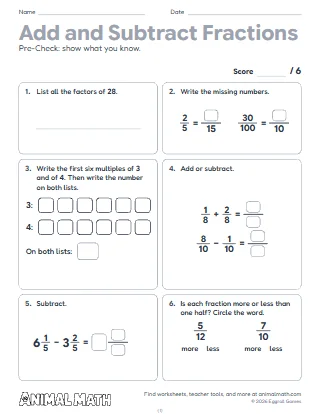
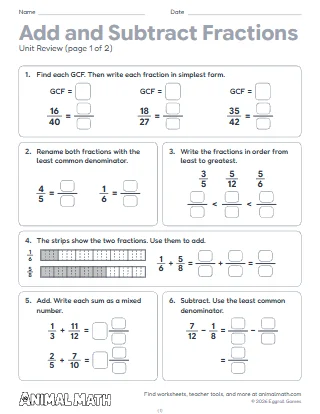
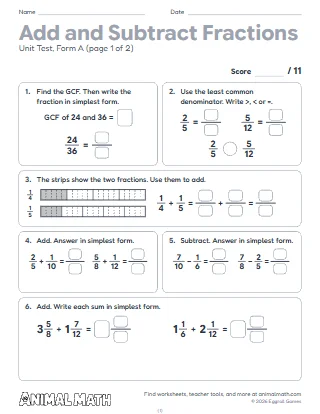
Weeks 13–15 · 12 days

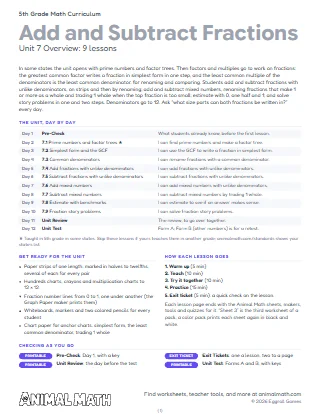
In some states the unit opens with prime numbers and factor trees. Then factors and multiples go to work on fractions: the greatest common factor writes a fraction in simplest form in one step, and the least common multiple of the denominators is the least common denominator, for renaming and comparing. Students add and subtract fractions with unlike denominators, on strips and then by renaming; add and subtract mixed numbers, renaming fractions that make 1 or more as a whole and trading 1 whole when the top fraction is too small; estimate with 0, one half and 1; and solve story problems in one and two steps. Denominators go to 12. Ask “what size parts can both fractions be written in?” every day.

Week 13 (continued)
Day 63Pre-CheckWhat students already know, before the unit.
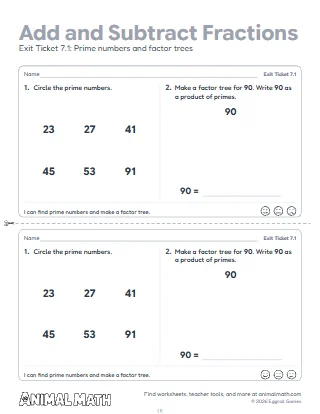
Day 647.1 Prime numbers and factor trees ★I can find prime numbers and make a factor tree.
Day 657.2 Simplest form and the GCFI can use the GCF to write a fraction in simplest form.
Week 14
Day 667.3 Common denominatorsI can rename fractions with a common denominator.
Day 677.4 Add fractions with unlike denominatorsI can add fractions with unlike denominators.
Day 687.5 Subtract fractions with unlike denominatorsI can subtract fractions with unlike denominators.
Day 697.6 Add mixed numbersI can add mixed numbers with unlike denominators.
Day 707.7 Subtract mixed numbersI can subtract mixed numbers by trading 1 whole.
Week 15
Day 717.8 Estimate with benchmarksI can estimate to see if an answer makes sense.
Day 727.9 Fraction story problemsI can solve fraction story problems.
Day 73Unit ReviewThe review, to go over together.
Day 74Unit TestForm A; Form B (other numbers) is for a retest.
Unit 8

Multiplying Fractions

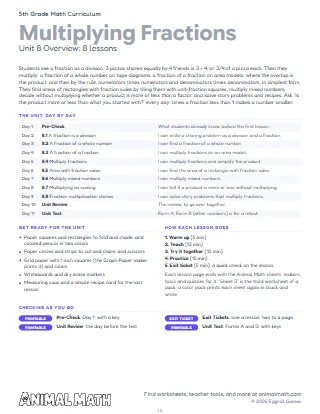
Weeks 15–17 · 11 days

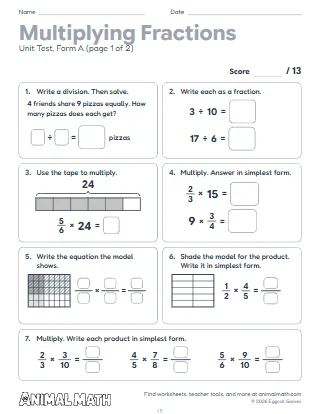
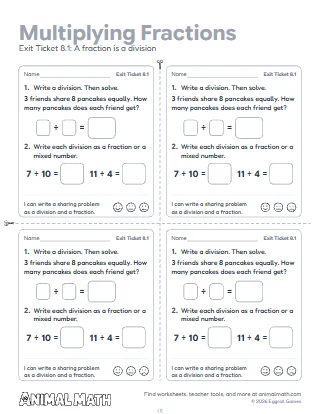
Students see a fraction as a division: 3 pizzas shared equally by 4 friends is 3 ÷ 4, or 3/4 of a pizza each. Then they multiply: a fraction of a whole number on tape diagrams, a fraction of a fraction on area models, where the overlap is the product, and then by the rule, numerators times numerators and denominators times denominators, in simplest form. They find areas of rectangles with fraction sides by tiling them with unit-fraction squares, multiply mixed numbers, decide without multiplying whether a product is more or less than a factor, and solve story problems and recipes. Ask “is the product more or less than what you started with?” every day: times a fraction less than 1 makes a number smaller.

Week 15 (continued)
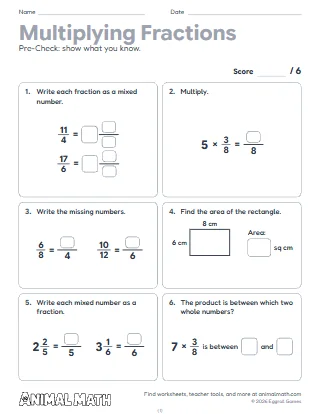
Day 75Pre-CheckWhat students already know, before the unit.
Week 16
Day 768.1 A fraction is a divisionI can write a sharing problem as a division and a fraction.
Day 778.2 A fraction of a whole numberI can find a fraction of a whole number.
Day 788.3 A fraction of a fractionI can multiply fractions on an area model.
Day 798.4 Multiply fractionsI can multiply fractions and simplify the product.
Day 808.5 Area with fraction sidesI can find the area of a rectangle with fraction sides.
Week 17
Day 818.6 Multiply mixed numbersI can multiply mixed numbers.
Day 828.7 Multiplying as scalingI can tell if a product is more or less without multiplying.
Day 838.8 Fraction multiplication storiesI can solve story problems that multiply fractions.
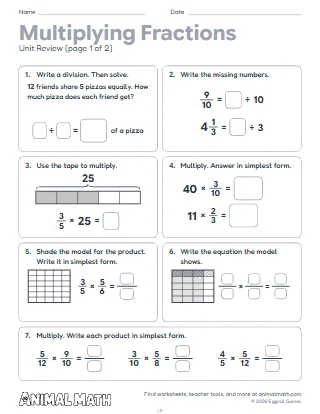
Day 84Unit ReviewThe review, to go over together.
Day 85Unit TestForm A; Form B (other numbers) is for a retest.
Unit 9

Dividing Fractions

Weeks 18–20 · 11 days

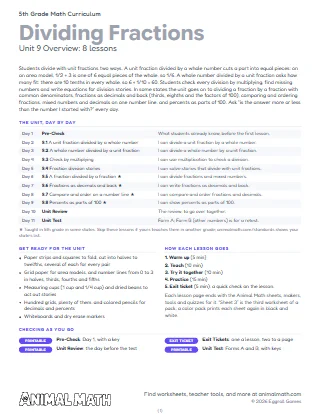
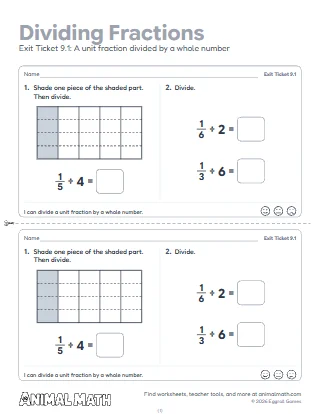
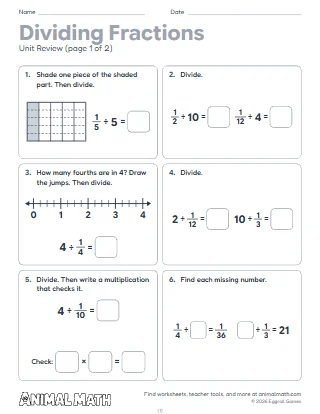
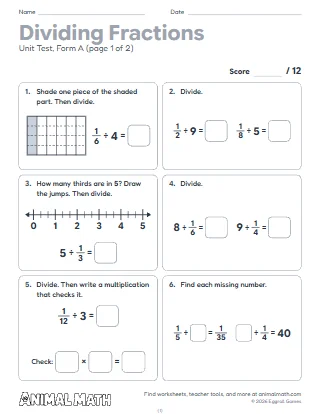
Students divide with unit fractions two ways. A unit fraction divided by a whole number cuts a part into equal pieces: on an area model, 1/2 ÷ 3 is one of 6 equal pieces of the whole, so 1/6. A whole number divided by a unit fraction asks how many fit: there are 10 tenths in every whole, so 6 ÷ 1/10 = 60. Students check every division by multiplying, find missing numbers and write equations for division stories. In some states the unit goes on to dividing a fraction by a fraction with common denominators, fractions as decimals and back (thirds, eighths and the factors of 100), comparing and ordering fractions, mixed numbers and decimals on one number line, and percents as parts of 100. Ask “is the answer more or less than the number I started with?” every day.

Week 18
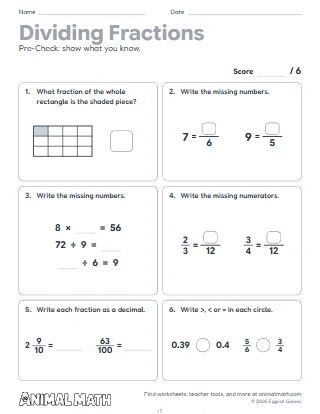
Day 86Pre-CheckWhat students already know, before the unit.
Day 879.1 A unit fraction divided by a whole numberI can divide a unit fraction by a whole number.
Day 889.2 A whole number divided by a unit fractionI can divide a whole number by a unit fraction.
Day 899.3 Check by multiplyingI can use multiplication to check a division.
Day 909.4 Fraction division storiesI can solve stories that divide with unit fractions.
Week 19
Day 919.5 A fraction divided by a fraction ★I can divide fractions and mixed numbers.
Day 929.6 Fractions as decimals and back ★I can write fractions as decimals and back.
Day 939.7 Compare and order on a number line ★I can compare and order fractions and decimals.
Day 949.8 Percents as parts of 100 ★I can show percents as parts of 100.
Day 95Unit ReviewThe review, to go over together.
Week 20
Day 96Unit TestForm A; Form B (other numbers) is for a retest.
Unit 10

Measurement Conversions

Weeks 20–22 · 11 days

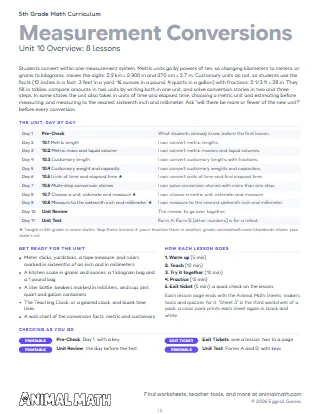
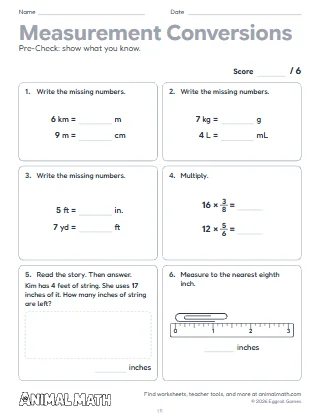
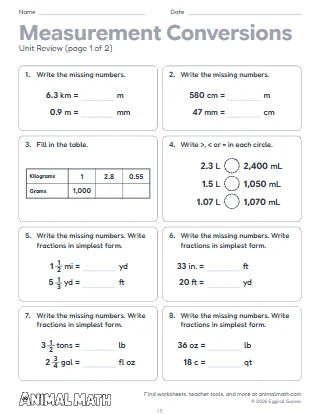
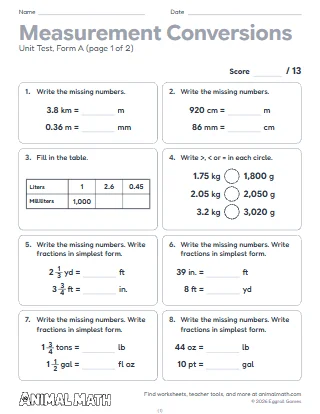
Students convert within one measurement system. Metric units go by powers of ten, so changing kilometers to meters, or grams to kilograms, moves the digits: 2.9 km = 2,900 m and 270 cm = 2.7 m. Customary units do not, so students use the facts (12 inches in a foot, 3 feet in a yard, 16 ounces in a pound, 4 quarts in a gallon) with fractions: 2 1/3 ft = 28 in. They fill in tables, compare amounts in two units by writing both in one unit, and solve conversion stories in two and three steps. In some states the unit also takes in units of time and elapsed time, choosing a metric unit and estimating before measuring, and measuring to the nearest sixteenth inch and millimeter. Ask “will there be more or fewer of the new unit?” before every conversion.

Week 20 (continued)
Day 97Pre-CheckWhat students already know, before the unit.
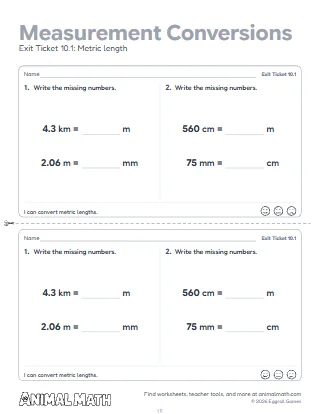
Day 9810.1 Metric lengthI can convert metric lengths.
Day 9910.2 Metric mass and liquid volumeI can convert metric masses and liquid volumes.
Day 10010.3 Customary lengthI can convert customary lengths with fractions.
Week 21
Day 10110.4 Customary weight and capacityI can convert customary weights and capacities.
Day 10210.5 Units of time and elapsed time ★I can convert units of time and find elapsed time.
Day 10310.6 Multi-step conversion storiesI can solve conversion stories with more than one step.
Day 10410.7 Choose a unit, estimate and measure ★I can choose a metric unit, estimate and measure.
Day 10510.8 Measure to the sixteenth inch and millimeter ★I can measure to the nearest sixteenth inch and millimeter.
Week 22
Day 106Unit ReviewThe review, to go over together.
Day 107Unit TestForm A; Form B (other numbers) is for a retest.
Unit 11

Solid Figures and Volume

Weeks 22–24 · 13 days

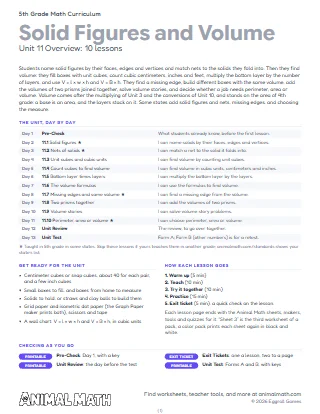
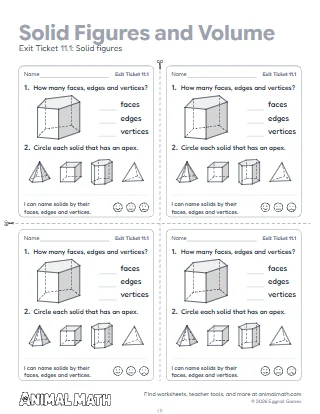
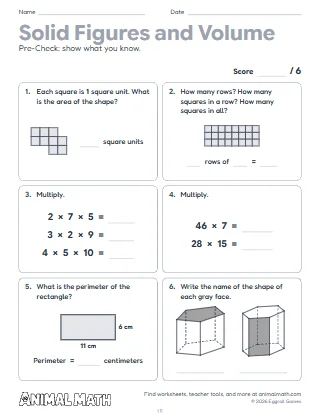
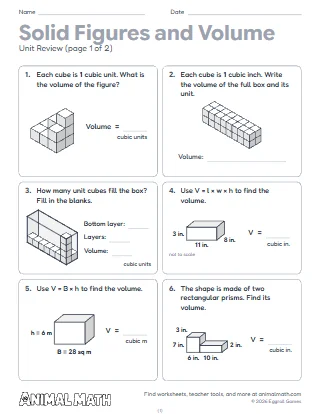
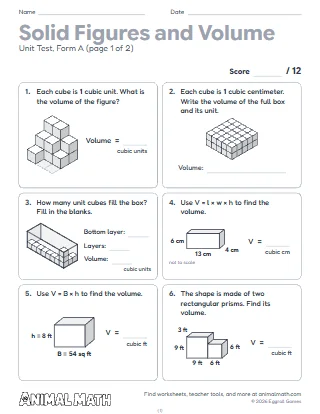
Students name solid figures by their faces, edges and vertices and match nets to the solids they fold into. Then they find volume: they fill boxes with unit cubes, count cubic centimeters, inches and feet, multiply the bottom layer by the number of layers, and use V = l × w × h and V = B × h. They find a missing edge, build different boxes with the same volume, add the volumes of two prisms joined together, solve volume stories, and decide whether a job needs perimeter, area or volume. Volume comes after the multiplying of Unit 3 and the conversions of Unit 10, and stands on the area of 4th grade: a base is an area, and the layers stack on it. Some states add solid figures and nets, missing edges, and choosing the measure.

Week 22 (continued)
Day 108Pre-CheckWhat students already know, before the unit.
Day 10911.1 Solid figures ★I can name solids by their faces, edges and vertices.
Day 11011.2 Nets of solids ★I can match a net to the solid it folds into.
Week 23
Day 11111.3 Unit cubes and cubic unitsI can find volume by counting unit cubes.
Day 11211.4 Count cubes to find volumeI can find volume in cubic units, centimeters and inches.
Day 11311.5 Bottom layer times layersI can multiply the bottom layer by the layers.
Day 11411.6 The volume formulasI can use the formulas to find volume.
Day 11511.7 Missing edges and same volume ★I can find a missing edge from the volume.
Week 24
Day 11611.8 Two prisms togetherI can add the volumes of two prisms.
Day 11711.9 Volume storiesI can solve volume story problems.
Day 11811.10 Perimeter, area or volume ★I can choose perimeter, area or volume.
Day 119Unit ReviewThe review, to go over together.
Day 120Unit TestForm A; Form B (other numbers) is for a retest.
Unit 12

Shapes and Angles

Weeks 25–27 · 11 days

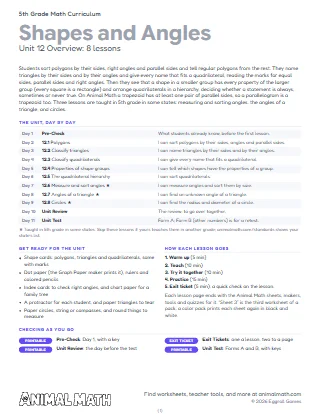
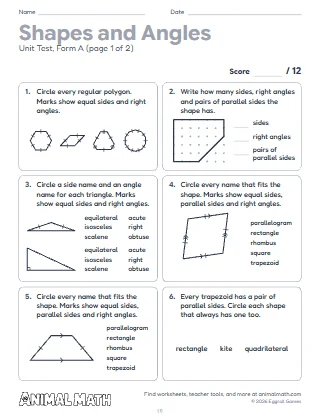
Students sort polygons by their sides, right angles and parallel sides and tell regular polygons from the rest. They name triangles by their sides and by their angles and give every name that fits a quadrilateral, reading the marks for equal sides, parallel sides and right angles. Then they see that a shape in a smaller group has every property of the larger group (every square is a rectangle) and arrange quadrilaterals in a hierarchy, deciding whether a statement is always, sometimes or never true. On Animal Math a trapezoid has at least one pair of parallel sides, so a parallelogram is a trapezoid too. Three lessons are taught in 5th grade in some states: measuring and sorting angles, the angles of a triangle, and circles.

Week 25
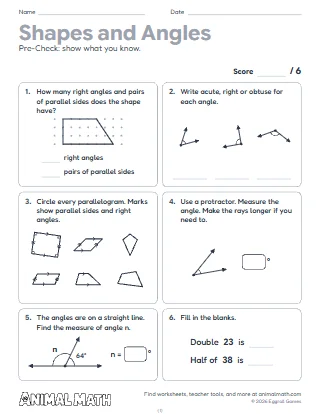
Day 121Pre-CheckWhat students already know, before the unit.
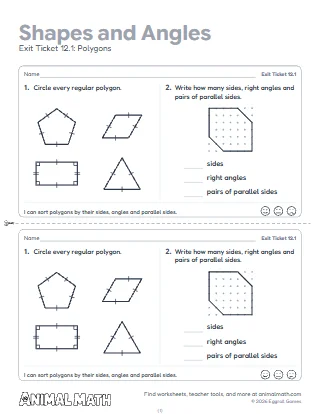
Day 12212.1 PolygonsI can sort polygons by their sides, angles and parallel sides.
Day 12312.2 Classify trianglesI can name triangles by their sides and by their angles.
Day 12412.3 Classify quadrilateralsI can give every name that fits a quadrilateral.
Day 12512.4 Properties of shape groupsI can tell which shapes have the properties of a group.
Week 26
Day 12612.5 The quadrilateral hierarchyI can sort quadrilaterals.
Day 12712.6 Measure and sort angles ★I can measure angles and sort them by size.
Day 12812.7 Angles of a triangle ★I can find an unknown angle of a triangle.
Day 12912.8 Circles ★I can find the radius and diameter of a circle.
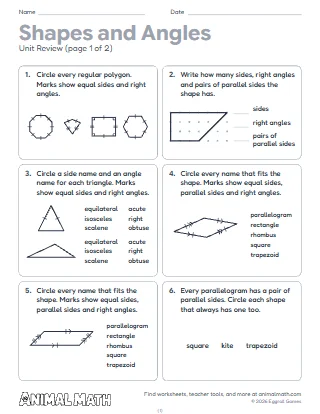
Day 130Unit ReviewThe review, to go over together.
Week 27
Day 131Unit TestForm A; Form B (other numbers) is for a retest.
Unit 13 ★

Area and Perimeter

Weeks 27–28 · 9 days

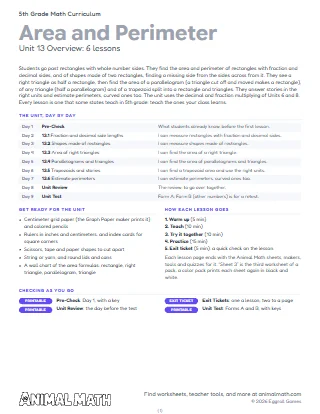
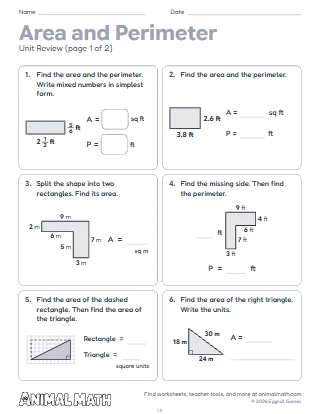
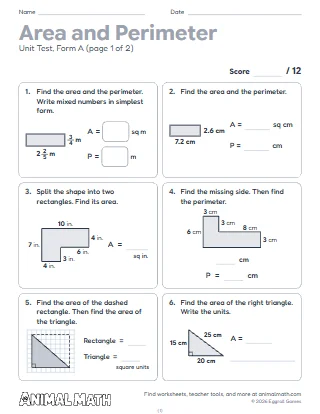
Students go past rectangles with whole number sides. They find the area and perimeter of rectangles with fraction and decimal sides, and of shapes made of two rectangles, finding a missing side from the sides across from it. They see a right triangle as half a rectangle, then find the area of a parallelogram (a triangle cut off and moved makes a rectangle), of any triangle (half a parallelogram) and of a trapezoid split into a rectangle and triangles. They answer stories in the right units and estimate perimeters, curved ones too. The unit uses the decimal and fraction multiplying of Units 6 and 8. Every lesson is one that some states teach in 5th grade: teach the ones your class learns.

Week 27 (continued)
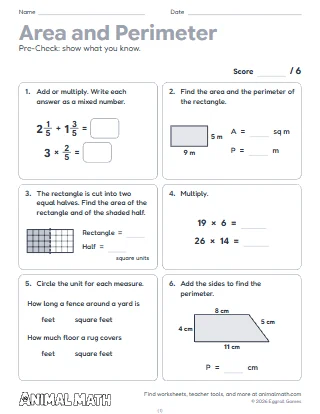
Day 132Pre-CheckWhat students already know, before the unit.
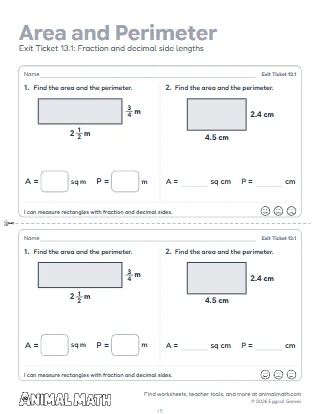
Day 13313.1 Fraction and decimal side lengthsI can measure rectangles with fraction and decimal sides.
Day 13413.2 Shapes made of rectanglesI can measure shapes made of rectangles.
Day 13513.3 Area of right trianglesI can find the area of a right triangle.
Week 28
Day 13613.4 Parallelograms and trianglesI can find the area of parallelograms and triangles.
Day 13713.5 Trapezoids and storiesI can find a trapezoid area and use the right units.
Day 13813.6 Estimate perimetersI can estimate perimeters, curved ones too.
Day 139Unit ReviewThe review, to go over together.
Day 140Unit TestForm A; Form B (other numbers) is for a retest.
Unit 14

Coordinate Plane and Patterns

Weeks 29–31 · 12 days

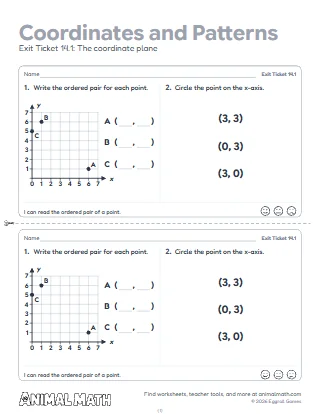
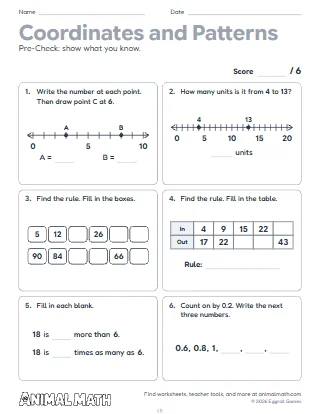
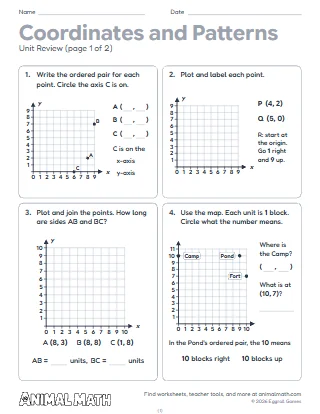
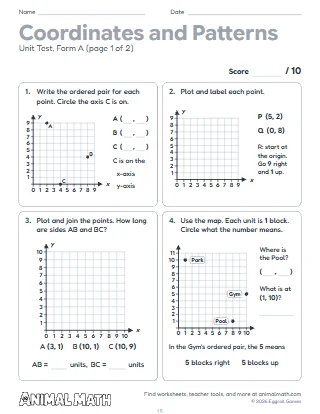
Students learn the first quadrant of the coordinate plane: the x-axis, the y-axis, the origin and ordered pairs. They read and plot points, join points into shapes and find lengths along grid lines, and tell what a point means on a map or a graph. Then they make two number patterns from two rules, compare the terms that line up, and graph the pairs. Three lessons are taught in 5th grade in some states: input-output rules written with n, telling adding patterns from multiplying ones, and patterns with fractions and decimals. Say “across, then up” every day.

Week 29
Day 141Pre-CheckWhat students already know, before the unit.
Day 14214.1 The coordinate planeI can read the ordered pair of a point.
Day 14314.2 Plot pointsI can plot a point from its ordered pair.
Day 14414.3 Join points; lengths on the gridI can join points and find a length along a grid line.
Day 14514.4 Points that tell a storyI can tell what a point on a map means.
Week 30
Day 14614.5 Two patterns from two rulesI can make two patterns and compare their terms.
Day 14714.6 Graph the pairs of two patternsI can graph the pairs of two patterns.
Day 14814.7 Input-output tables ★I can write the rule of a table as an expression.
Day 14914.8 Add or multiply? ★I can tell an adding pattern from a multiplying one.
Day 15014.9 Patterns with fractions and decimals ★I can extend patterns with fractions and decimals.
Week 31
Day 151Unit ReviewThe review, to go over together.
Day 152Unit TestForm A; Form B (other numbers) is for a retest.
Unit 15

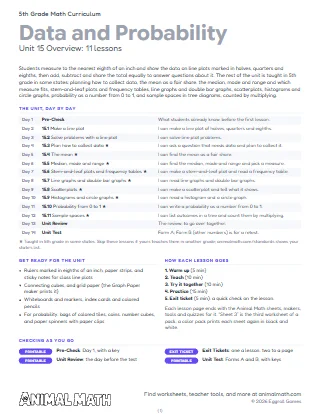
Data and Probability

Weeks 31–34 · 14 days

Students measure to the nearest eighth of an inch and show the data on line plots marked in halves, quarters and eighths, then add, subtract and share the total equally to answer questions about it. The rest of the unit is taught in 5th grade in some states: planning how to collect data, the mean as a fair share, the median, mode and range and which measure fits, stem-and-leaf plots and frequency tables, line graphs and double bar graphs, scatterplots, histograms and circle graphs, probability as a number from 0 to 1, and sample spaces in tree diagrams, counted by multiplying.

Week 31 (continued)
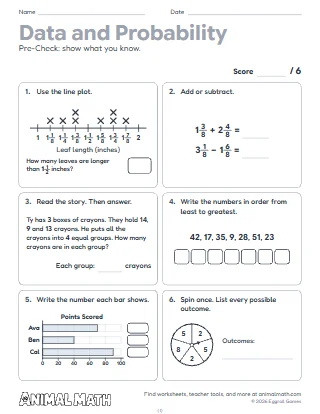
Day 153Pre-CheckWhat students already know, before the unit.
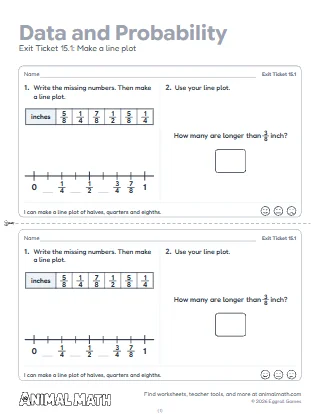
Day 15415.1 Make a line plotI can make a line plot of halves, quarters and eighths.
Day 15515.2 Solve problems with a line plotI can solve line plot problems.
Week 32
Day 15615.3 Plan how to collect data ★I can ask a question that needs data and plan to collect it.
Day 15715.4 The mean ★I can find the mean as a fair share.
Day 15815.5 Median, mode and range ★I can find the median, mode and range and pick a measure.
Day 15915.6 Stem-and-leaf plots and frequency tables ★I can make a stem-and-leaf plot and read a frequency table.
Day 16015.7 Line graphs and double bar graphs ★I can read line graphs and double bar graphs.
Week 33
Day 16115.8 Scatterplots ★I can make a scatterplot and tell what it shows.
Day 16215.9 Histograms and circle graphs ★I can read a histogram and a circle graph.
Day 16315.10 Probability from 0 to 1 ★I can write a probability as a number from 0 to 1.
Day 16415.11 Sample spaces ★I can list outcomes in a tree and count them by multiplying.
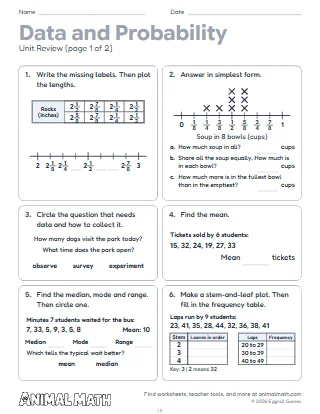
Day 165Unit ReviewThe review, to go over together.
Week 34
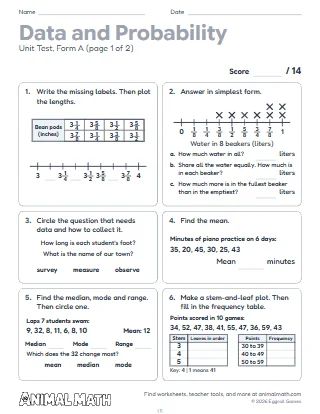
Day 166Unit TestForm A; Form B (other numbers) is for a retest.
Unit 16 ★

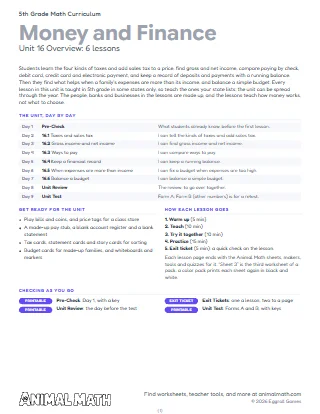
Money and Financial Literacy

Weeks 34–35 · 9 days

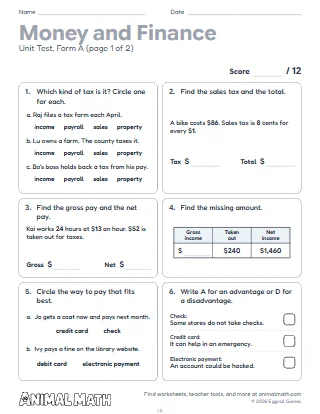
Students learn the four kinds of taxes and add sales tax to a price, find gross and net income, compare paying by check, debit card, credit card and electronic payment, and keep a record of deposits and payments with a running balance. Then they find what helps when a family’s expenses are more than its income, and balance a simple budget. Every lesson in this unit is taught in 5th grade in some states only, so teach the ones your state lists; the unit can be spread through the year. The people, banks and businesses in the lessons are made up, and the lessons teach how money works, not what to choose.

Week 34 (continued)
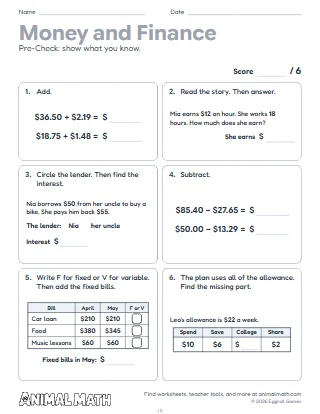
Day 167Pre-CheckWhat students already know, before the unit.
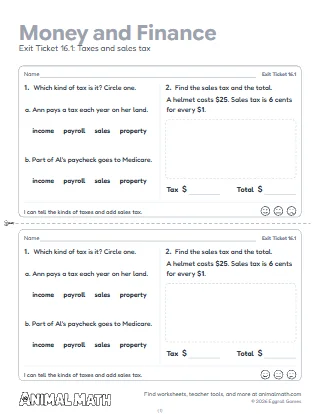
Day 16816.1 Taxes and sales taxI can tell the kinds of taxes and add sales tax.
Day 16916.2 Gross income and net incomeI can find gross income and net income.
Day 17016.3 Ways to payI can compare ways to pay.
Week 35
Day 17116.4 Keep a financial recordI can keep a running balance.
Day 17216.5 When expenses are more than incomeI can fix a budget when expenses are too high.
Day 17316.6 Balance a budgetI can balance a simple budget.
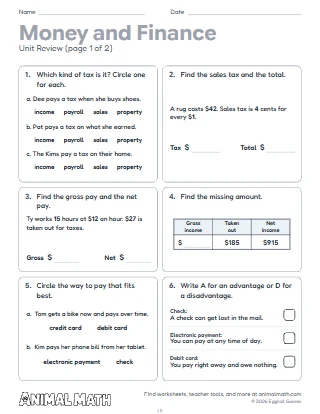
Day 174Unit ReviewThe review, to go over together.
Day 175Unit TestForm A; Form B (other numbers) is for a retest.

Lessons marked ★ are taught in 5th grade in some states and in other grades elsewhere; skip them if your state does not teach them in 5th grade (without them the year is 81 lessons in 14 units, which leaves time to spend two days on the long division, decimal and fraction lessons). The two line plot lessons that open Unit 15 can close Unit 9 instead. Units 13 (area and perimeter of polygons) and 16 (money and financial literacy) are for the states that teach them in 5th grade, and Unit 16 can be spread through the year.

Teaching a grade we don’t cover yet?

Tell us which grade you want a curriculum for next.

Suggest a curriculum

A free curriculum

Every lesson plan, exit ticket and unit test here is free to download and print for your classroom or your home school. You do not need an account, and the PDFs have no watermarks.